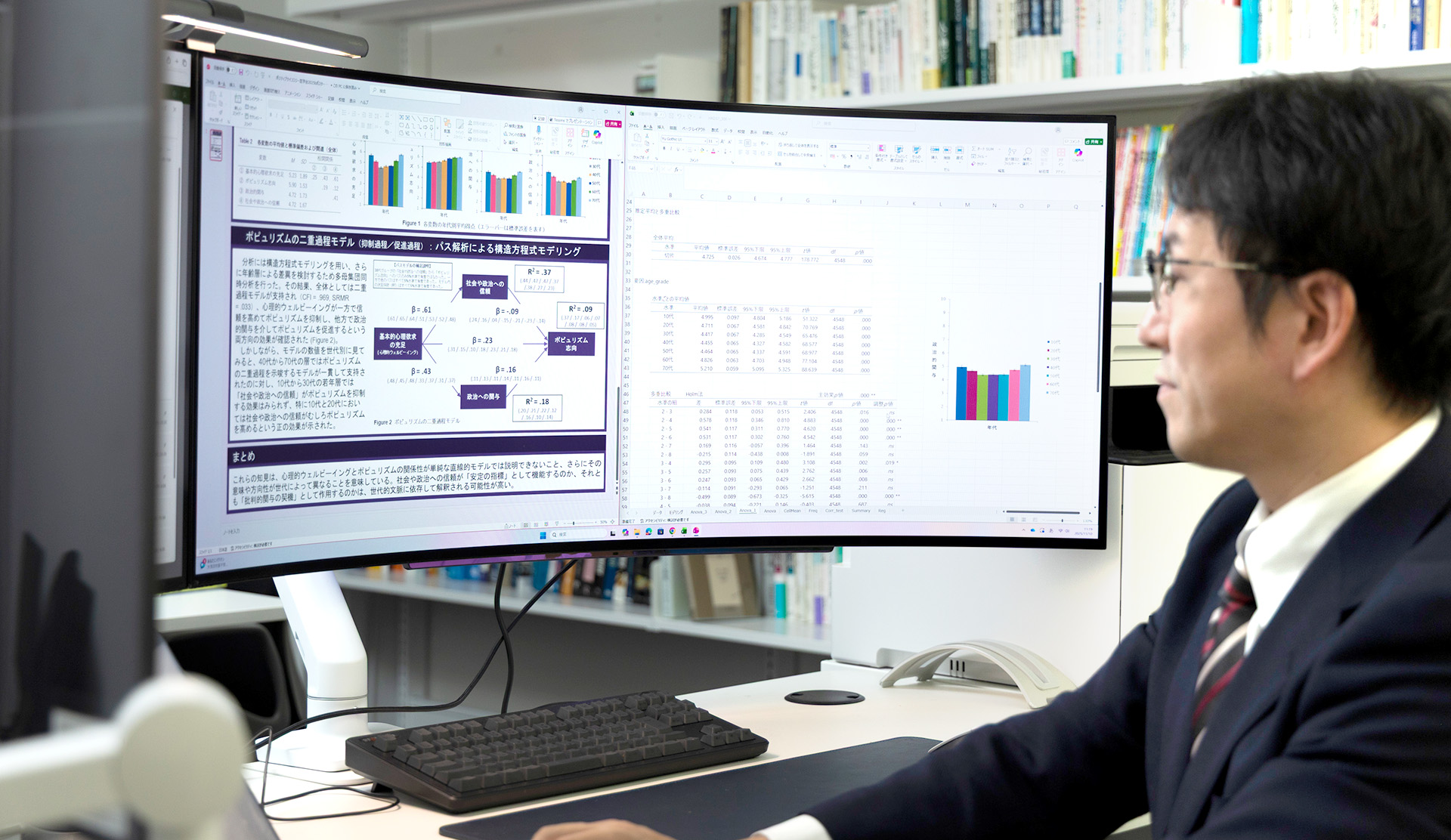
In today's digital society overflowing with information, it is essential to discern the veracity of this information to then utilize it in addressing social problems. Science communication helps people find pathways toward solutions by providing accurate and advanced scientific knowledge. Over the 140 years since its establishment, Tokyo University of Science has engaged in in-depth scientific research that reflects its founding spirit of “Building a better future with Science." In this period of global transformation, Tokyo University of Science has established a Department of Science Communication, a unique department, seeking to cultivate professionals who can promote public understanding of science based on advanced scientific knowledge and accurate information.
Research Groups & Research Areas
-
Science Communication
This field cultivates the ability to critically evaluate information in an information-saturated society and to address social challenges by utilizing science and technology. Students will develop the ability to connect science, society, and people's lives through a broad range of studies including educational technology, learning science, and psychology. Furthermore, they will improve their ability to communicate from a scientific perspective by linking it with knowledge in information and data science, mathematics, and science.
Ikkatai Research Group / Oura Research Group / Okiharu Research Group / Suzuki Research Group / Takemura Research Group / Nishimura Research Group / Watanabe Research Group
-
Information and Data Science
In the area of information and data science, students will develop the knowledge and skills needed to organize, integrate, and analyze various types of data to derive valuable insights. They will utilize statistics, machine learning, and programming to acquire specialized knowledge in everything from survey design to data collection and processing, visualization and prediction, and decision support. Students develop the ability to contribute to addressing scientific and social challenges.
Akakura Research Group / Oura Research Group / Shimokawa Research Group / Nishimura Research Group / Nishiyama Research Group
-
Mathematics
Mathematics underlies a great many phenomena. Therefore, mathematical understanding and communication are essential for scientific communication and addressing various social problems. University mathematics is divided into three areas: analysis, algebra, and geometry. Students are encouraged not only to solve problems but also to develop, analyze, and discuss mathematical theories.
Ito Research Group / Kozakai Research Group / Shimokawa Research Group / Nishiyama Research Group / Watanabe Research Group
-
Science
Science encompasses a wide range of disciplines, including physics, chemistry, biology, and earth science, and provides the foundation for scientific and technological advancement. In this field, students develop scientific knowledge, research skills, and science communication abilities, with a particular focus on physics and chemistry. In physics, students study topics ranging from classical physics, including mechanics and electromagnetism, to modern physics represented by quantum mechanics, as well as physics education. In chemistry, students gain a broad and balanced understanding of inorganic chemistry, physical chemistry, organic chemistry, biochemistry, life sciences, environmental science, and chemistry education. Through these studies, students learn not only to understand science deeply but also to communicate scientific knowledge and discoveries to society in a clear and accessible manner.
Okiharu Research Group / Suzuki Research Group / Takemura Research Group
List of Faculty Members
| Name | Title | Research Area |
|---|---|---|
| AKAKURA Takako | Professor | Intelligent informatics (Machine learning/Natural language processing) Educational technology (e-Learning System/e-Testing System) Control engineering/System engineering (Authentication technology for e-Testing and e-Learning) |
| IKKATAI Yuko | Professor | Sociology/History of science and technology (citizen science, open science) Gender (Gender gap in STEM education) |
| NISHIYAMA Takahiro | Professor | Statistical science (Multivariate analysis) Foundations of mathematics/Applied mathematics (Mathematical statistics) |
| OKIHARU Fumiko | Professor | Science education |
| OURA Hiroki | Professor | Educational technology (Learning Sciences, Flipped Classroom, MOOC, Learning Analytics) |
| TAKEMURA Masaharu | Professor | Education on school subjects and activities (Biology education, Virus education) Aquatic life science (Giant virus, Origin of eukaryotic cell nucleus) |
| WATANABE Yuki | Professor | Science education Educational technology |
| ITO Hiroyuki | Professor | Theory of informatics (Applied Algebra) Computational science Algebra (Algebebraic Geometry) Geometry Foundations of mathematics/Applied mathematics (Applied Algebra) |
| NISHIMURA Takuma | Associate Professor | Educational psychology (motivation, self-control, school adjustment, social development) |
| SHIMOKAWA Asanao | Associate Professor | Foundations of mathematics/Applied mathematics (Applied statistics, Machine learning, Survival time analysis, Tree-structured model) |
| KOZAKAI Yuta | Junior Associate Professor | Algebra (Representation theory of finite groups, Representation theory of algebras) |
| SUZUKI Takahiro | Junior Associate Professor | Science education (Chemical education) |
| HIRAMAE Naoya | Assistant Professor | Algebra (Representation theory of algebras, Representation theory of finite groups) |
| KONDO Takaki | Assistant Professor | Educational technology (Collaborative Learning, CSCL, Self-Regulated Learning) |
| NAKAJIMA Yuto | Assistant Professor | Physical chemistry (Spectroscopy, Reaction kinetics, DFT calculations) |
| NAKAMURA Kento | Assistant Professor | Educational technology (Instructional Design, Teacher Training) |
| TANIGUCHI Kitaro | Assistant Professor | Education on school subjects and activities (Physics Education Research) Particle/Nuclear/Cosmic ray/Astro physics (Cosmology, Dark energy, Gravitational theory, Black hole) |
Information on Career Paths
As this department is newly established in April 2026, the department has not yet produced graduates. However, a wide range of career paths are possible, including teaching at junior and senior high schools, working as a policy planning and formulation, working in mass media such as television and newspapers, and in public relations at manufacturers and R&D ventures. For those pursuing graduate studies, students may pursue graduate study in the Department of Mathematics and Science Education within the Graduate School of Science, as well as to a wide range of other science-related areas, is envisioned.
Junior high school teacher (mathematics/science), senior high school teacher (mathematics/science/information technology), education industry, government agencies, local governments, mass media, science and technology public relations for manufacturers, R&D ventures, X-Tech companies, data scientists, data architects, graduate school admissions, etc.