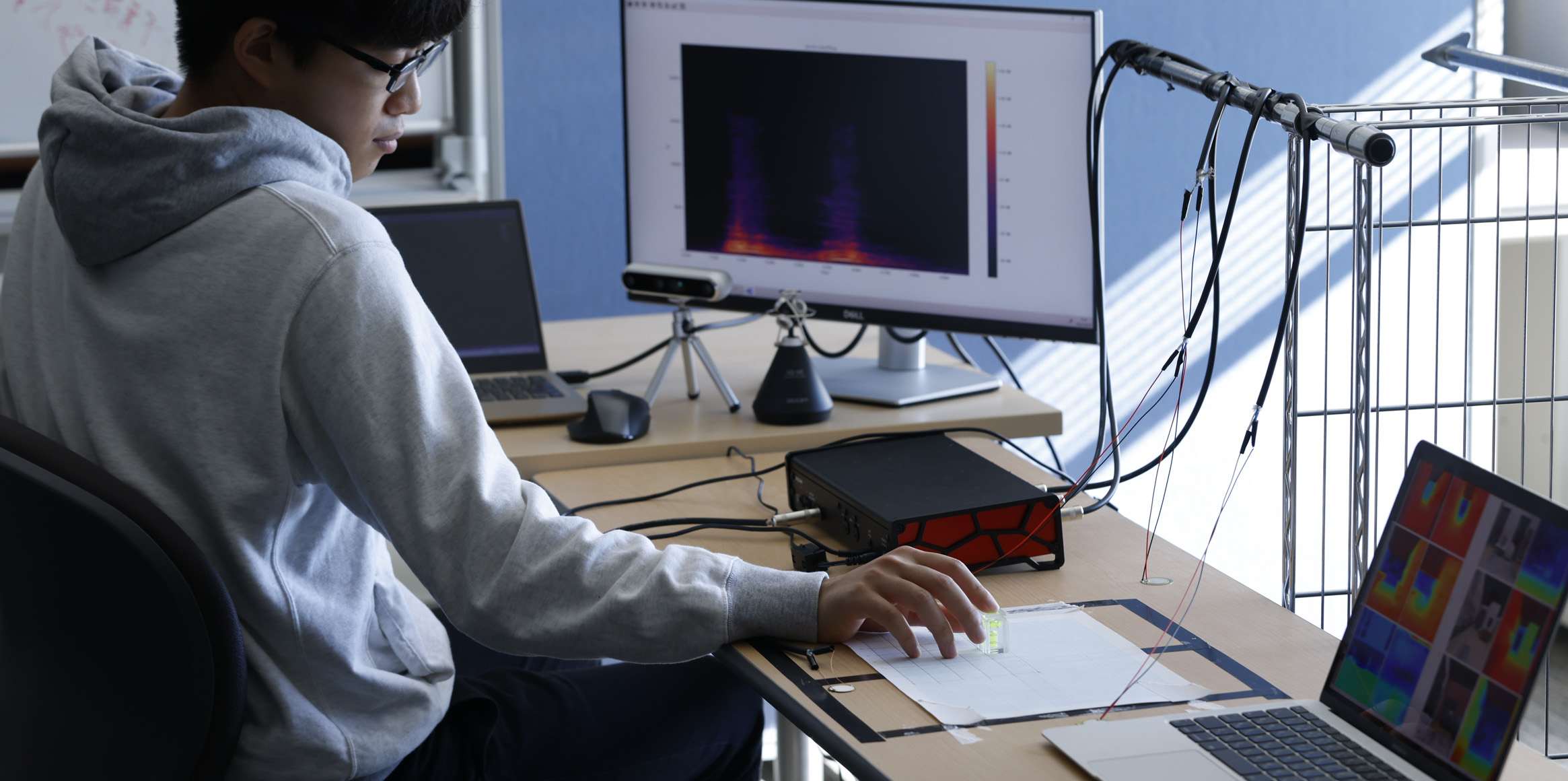
Information engineering is indispensable technology for the realization and evolvement of a fertile human society.
The creation, communication, and processing of diverse media information contribute to the establishment of a bountiful future society, and the building of a firm foundation which enables nature, people and society to prosper in harmony.
In this department, students first master the fundamentals of information engineering such as network and software technologies, then move on to acquire skills in integrating various elemental technologies necessary to create and design systems that support the building of a safe and secure society.
Research Groups & Research Areas
-
Social Design
We address issues to be solved in modern times from the perspective of social design. Major themes include the design of systems for education, logistics, medical and health services, as well as disaster control, while applying a wide range of information technology. We also create new business models coming along with these systems.
Akakura Research Group / Taniguchi Research Group
-
Data Science
We seek to understand the world through data and to unravel its complexities. Our primary focus is on using statistical methods, causal inference, machine learning and other approaches to scientifically analyze data in order to gain new insights and build various systems.
Irie Research Group / Shinozaki Research Group / Sozu Research Group
-
Software Design
As a fundamental technology supporting the realization of a ubiquitous society and other aspects of a diversified information society, we aim to create information networks that offer advanced security and even higher performance and functionality. Major themes include proposing new distributed processing, and cloud technologies.
Fujisawa Research Group / Ikebe Research Group / Okadome Research Group / Onizawa Research Group
-
Intelligent Systems
We design systems while analyzing and understanding the nature of the human intellect, in order to offer true assistance for human activities. Major themes include signal processing technologies adapted to robots with learning functions, and biometric information of humans, as well as the further development of media technology and the creation of new technologies.
Ikeguchi Research Group / Nakamura Research Group / Tatsukawa Research Group
List of Faculty Members
| Name | Title | Research Area |
|---|---|---|
| IKEGUCHI Tohru | Professor | Kansei informatics (Nonlinear Science,Nonlinear dynamics and chaos, complex networks, mathematical agriculture) |
| IRIE Go | Professor | Perceptual information processing (Pattern Recognition) Intelligent informatics (Machine Learning) |
| ONIZAWA Takeshi | Professor | Communication/Network engineering (Wireless communication, Network, Information and communication technology) |
| SOZU Takashi | Professor | Statistical science (Medical research, Study design, Data analysis) |
| TANIGUCHI Yukinobu | Professor | Perceptual information processing (Visual Media Processing) |
| TATSUKAWA Tomoaki | Professor | Intelligent informatics (Multiobjective Design Exploration) Soft computing (Multiobjective Evolutionary Computing, Genetic Programming) |
| FUJISAWA Masaya | Associate Professor | Communication/Network engineering (Error correcting code) |
| NAKAMURA Kazuaki | Associate Professor | Information security (attacks against artificial intelligence (AI) and their defense) Perceptual information processing (image recognition and generation) Intelligent informatics (machine learning, artificial intelligence (AI)) |
| SHIBATA Tomohide | Associate Professor | Intelligent informatics (Natural Language Processing, Large Language Models, Artificial Intelligence) |
| TAMURA-IKEBE Yoshiko | Associate Professor | Foundations of mathematics/Applied mathematics (Combinatorial optimization) |
| OKADOME Yuya | Junior Associate Professor | Intelligent robotics (Human-robot interaction, Deep Learning, Machine Learning) |
| OHIGASHI Tomohiro | Assistant Professor | Statistical science (Biostatistics, Bayesian Statistics) |
| SAWADA Kazuya | Assistant Professor | Soft computing (Nonlinear time series analysis, Causality analysis, Complex network) |
| SO Etsu | Assistant Professor | |
| YANG ZEKUN | Assistant Professor | Perceptual information processing (Language Processing, Machine Learning) |
Information on Career Paths
-
Graduate School40.4%
-
Information Industry34.0%
-
Professional and Technical Services8.5%
-
Machinery and Appliances5.4%
-
Finance, Insurance2.1%
-
Wholesale and Retail Trade2.1%
-
Education, Learning Support2.1%
-
Academic research institutes1.1%
-
Miscellaneous Services1.1%
-
Electronic Parts1.1%
-
Other(Persons Planning on Continuing Education, Studying Abroad, etc.)2.1%