2026.11.11 Wednesday
A Gold-Copper Strategy for Building Interlocked Nitrogen-Doped Carbon Nanohoops
Researchers harness dynamic gold and copper bonds to synthesize a catenane and control its molecular handedness using a chiral guest
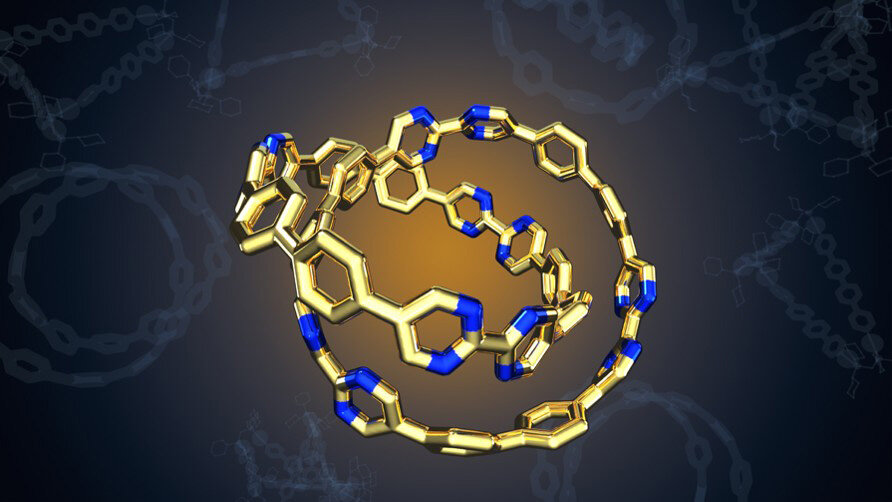
Catenanes are molecules in which two or more rings are mechanically interlocked like the links of a chain, without any chemical bonds between them. Since Jean-Pierre Sauvage, who later shared the 2016 Nobel Prize in Chemistry, reported an efficient metal-templated synthesis in 1983, catenanes have attracted attention as fundamental frameworks for molecular machines. Cycloparaphenylenes (CPPs) are curved ring-shaped molecules composed of para-linked benzene units and correspond to the shortest segments of carbon nanotubes. Catenanes composed of CPPs are therefore especially attractive because they combine mechanical interlocking with the distinctive properties of nanocarbon.
However, such catenanes are notoriously difficult to make. Because CPPs are highly strained, the strain must be introduced only after the rings are interlocked. Conventional approaches require carrying out several steps as separate, sequential stages, including temporarily linking partial frameworks of the two rings, closing the rings, and forming the strained CPP framework. These approaches typically involve more than 10 synthetic steps.
To address this challenge, a joint research team developed a simpler route to obtain nanohoop catenanes by combining gold and copper. Their work was published online in Angewandte Chemie International Edition on October 3, 2026, and was selected as a Hot Paper. The team was led by Associate Professor Tomohito Ide of the Department of Chemical Science and Engineering, National Institute of Technology, Tokyo College (NITTC) and Assistant Professor Yoshitaka Tsuchido of the Department of Chemistry, Tokyo University of Science (TUS), Japan, with key contributions from Hiromichi Yokoyama and Miki Kawata, two former undergraduate students at NITTC. Other collaborators included Assistant Professor Masahiro Hayakawa and Professor Takuji Hatakeyama from Kyoto University, Japan, as well as Professor Hidetoshi Kawai from TUS.
The key to this strategy lies in integrating two types of "dynamic" bonds that undergo reversible cleavage and reformation in solution: gold(I)-carbon σ-bonds in macrocyclic gold complexes, which underpin the gold-template method for CPP synthesis previously developed by members of the team, and copper(I)-nitrogen coordination bonds, inspired by Sauvage's classical copper-template approach. When the researchers added a copper(I) salt to a nitrogen-containing macrocyclic gold(I) complex and heated the mixture, the two types of dynamic bonds worked cooperatively to assemble an interlocked gold-copper complex in a single pot. Subsequent demetallation removed the metals, yielding a metal-free [2]catenane composed of two fully π-conjugated, nitrogen-doped [12]CPP-based nanohoops.
The entire synthesis requires only eight steps from commercially available starting materials, achieving an overall yield of 2.9%. This represents an efficient synthetic route compared to conventional approaches, which require more than 10 steps with overall yields ranging from 0.02% to 4.3%. Based on mass spectrometry measurements and quantum chemical calculations, the researchers proposed a mechanism in which copper(I) coordination serves as a template, driving the dynamic reorganization toward the catenane assembly.
The team also found that the catenane exhibits co-conformational chirality. Depending on the relative orientation of its two rings, it can adopt either a "right-handed" or a "left-handed" mirror-image form. Upon adding the chiral aluminum complex reagent, CASA-Na, circular dichroism spectroscopy showed that the molecule became biased toward one handedness depending on which enantiomer of the reagent was used. A non-interlocked nanohoop showed almost no such effect, confirming that this chirality originates from the interlocked structure.
"By combining two distinct dynamic bonding systems, we have developed an efficient strategy for constructing highly strained, fully conjugated catenanes through self-assembly. This approach could enable the precise synthesis of topologically complex π-electron nanomaterials. Furthermore, the ability to bias the handedness of these catenanes through guest complexation may open new possibilities for developing chiral materials with tunable optical and electronic properties, as well as advanced supramolecular nanomachines," highlights Dr. Tsuchido.
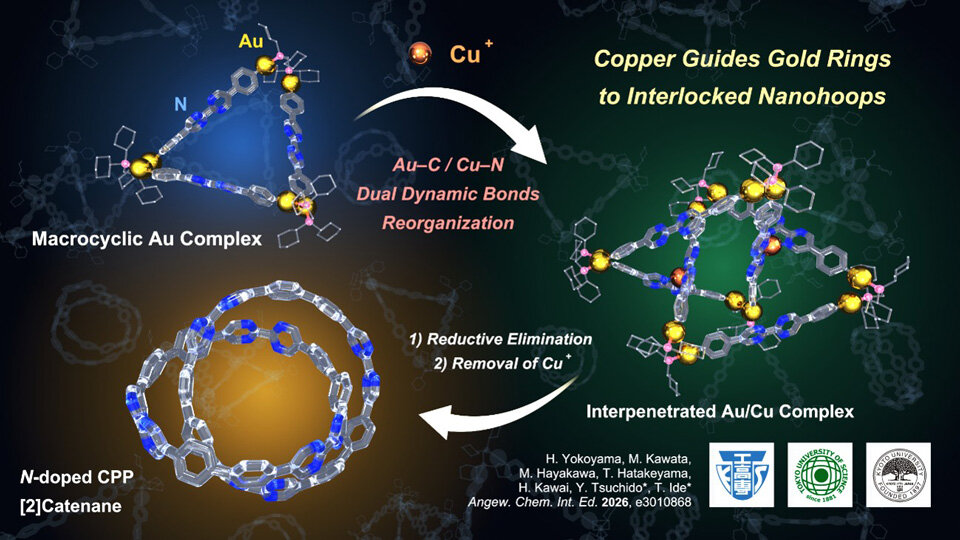
Image title: Gold-copper dynamic self-assembly of a nanohoop catenane
Image caption: By combining dynamic gold(I)-carbon σ-bonds with copper(I)-nitrogen coordination bonds, the researchers assembled a [2]catenane composed of two nitrogen-containing cycloparaphenylenes in fewer synthetic steps than conventional approaches.
Image credit: Assistant Professor Yoshitaka Tsuchido from Tokyo University of Science, Japan; and Associate Professor Tomohito Ide from National Institute of Technology, Tokyo College (NITTC), Japan
License type: Original content
Usage restrictions: Cannot be used without permission
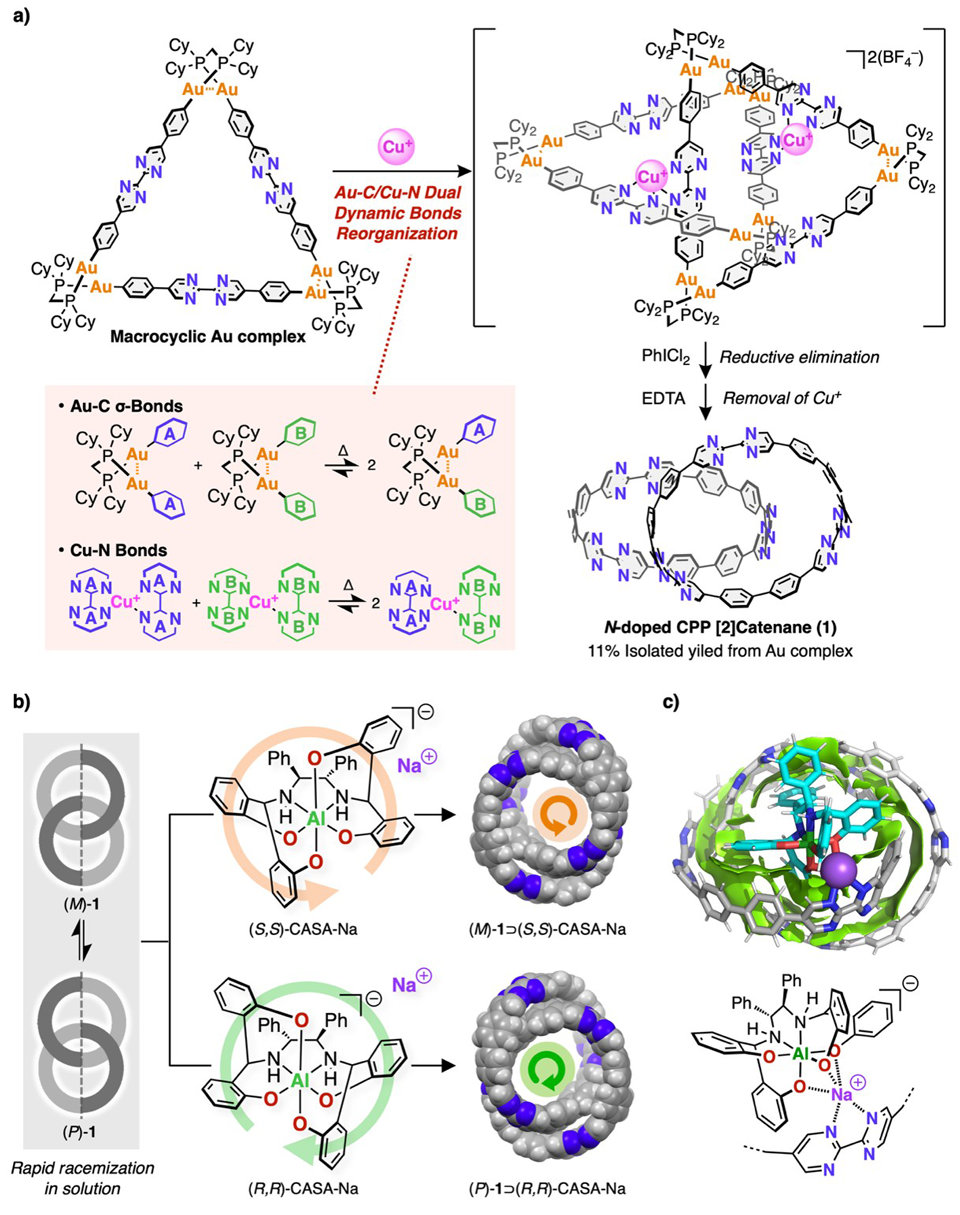
Image title: Gold-Copper Dynamic Assembly of an N-Doped [2]Catenane
Image caption: Researchers combine dynamic gold(I)-carbon σ-bonds and copper(I)-nitrogen coordination bonds to synthesize an interlocked [2]catenane composed of two N-doped cycloparaphenylene-based nanohoops. The resulting structure exhibits guest-induced biasing of its co-conformational handedness in the presence of chiral CASA-Na complexes.
Image credit: Assistant Professor Yoshitaka Tsuchido from Tokyo University of Science, Japan; and Associate Professor Tomohito Ide from National Institute of Technology, Tokyo College (NITTC), Japan
License type: Original content
Usage restrictions: Cannot be used without permission
Reference
| Title of original paper | : | Metal-Templated Dynamic Reorganization of Macrocyclic Gold Complexes toward an N-Doped Cycloparaphenylene Catenane |
| Journal | : | Angewandte Chemie International Edition |
| DOI | : | 10.1002/anie.3010868 |
| Authors | : | Hiromichi Yokoyama1, Miki Kawata1, Masahiro Hayakawa2, Takuji Hatakeyama2, Hidetoshi Kawai3, Yoshitaka Tsuchido3, and Tomohito Ide1 |
| Affiliations | : | 1Department of Chemical Science and Engineering, National Institute of Technology, Tokyo College, Japan 2Department of Chemistry, Graduate School of Science, Kyoto University, Japan 3Department of Chemistry, Faculty of Science, Tokyo University of Science, Japan |
About The Tokyo University of Science
Tokyo University of Science (TUS) is a well-known and respected university, and the largest science-specialized private research university in Japan, with four campuses in central Tokyo and its suburbs and in Hokkaido. Established in 1881, the university has continually contributed to Japan's development in science through inculcating the love for science in researchers, technicians, and educators.
With a mission of "Creating science and technology for the harmonious development of nature, human beings, and society," TUS has undertaken a wide range of research from basic to applied science. TUS has embraced a multidisciplinary approach to research and undertaken intensive study in some of today's most vital fields. TUS is a meritocracy where the best in science is recognized and nurtured. It is the only private university in Japan that has produced a Nobel Prize winner and the only private university in Asia to produce Nobel Prize winners within the natural sciences field.
■
Tokyo University of Science(About TUS)
About Professor Kawai Hidetoshi
from Tokyo University of Science
About Assistant Professor Yoshitaka Tsuchido
from Tokyo University of Science
Funding information
This work was financially supported by JSPS KAKENHI grant numbers 21H05496 and 23H04041 (Grants-in-Aid for Transformative Research Areas (A), Condensed Conjugation) to Yoshitaka Tsuchido, and 25K08686 (Grant-in-Aid for Scientific Research (C)) to Tomohito Ide. Yoshitaka Tsuchido also acknowledges financial support from the Tokuyama Science Foundation. Some of the computations were performed at the Research Center for Computational Science, Okazaki Research Facilities, National Institutes of Natural Sciences (project numbers 21-IMS-C158, 22-IMS-C158, 24-IMS-C166, and 25-IMS-C184 for Tomohito Ide). The X-ray crystal structure analysis was performed at BL40XU of SPring-8 with the approval of JASRI (2022B1149 and 2023A1337). Support from the Cooperative Research Program of the "Network Joint Research Center for Materials and Devices," MEXT, Japan (20241225 for Hidetoshi Kawai), is gratefully recognized.