2026.08.31 Monday
Thermal Self-Organization in Volatile Resistive Switching Revealed by NMR
Researchers uncover the role of Joule heating and underlying mechanisms in resistive switching in a bulk organic conductor

Metal-insulator transitions (MITs), where a material changes from a metallic state with low resistivity to an insulating state due to a change in an external parameter, such as temperature, pressure, or an electric field, are a central topic in fundamental physics research. In materials that undergo MITs, it has also been observed that, in the insulating phase but near the transition point, applying an electric field or current can sometimes trigger a sudden drop in resistance, known as resistive switching. This volatile resistive switching holds promise for various innovative applications, including resistive memories, optoelectronics, and neuromorphic computing, which is key for artificial intelligence implementation.
However, the fundamental mechanism behind this phenomenon remains poorly understood. Although Joule heating is known to play an important role, it has been difficult to determine how heat generation and dissipation couple to the MIT to stabilize a resistive-switched state. A key reason is that this phenomenon has mainly been studied in inorganic thin films, where strong heat flow into the substrate and relatively broad MITs can obscure the nonlinear thermal response.
In a new study, a research team led by Professor Tetsuaki Itou from the Department of Applied Physics at Tokyo University of Science (TUS) in Japan, addressed this issue by investigating a resistive-switched state in a bulk organic conductor, exhibiting an extremely sharp MIT and weak heat dissipation. "While resistive switching is actively studied from a device application perspective, what actually happens inside the material during this process is not always fully understood," explains Prof. Itou. "In this study, we present an experimental elucidation of the volatile resistive-switched state, aiming to establish a microscopic basis for understanding the thermal self-organization that links phase coexistence, heat flow, and electrical transport."
The team also included Riku Ishii and Assistant Professor Takayoshi Kouchi, both from TUS; Dr. Hiroshi Oike from the National Institute for Materials Science, Japan; Professor Fumitaka Kagawa from the Institute of Science Tokyo, Japan; and Dr. Reizo Kato from RIKEN, Cluster for Pioneering Research, Japan. Their study was published in Volume 26, Issue 2 of Physical Review Applied on August 17, 2026, and was selected as an Editors' Suggestion.
The researchers investigated a needle-like crystal of the organic conductor (d7-DMe-DCNQI)2Cu, a deuterated derivative of N,N′ dicyanoquinonediimine (DCNQI). This material exhibits a sharp MIT on heating and cooling around a transition temperature of 79 K. Specifically, it exhibits a metallic phase above 79 K, and an insulating phase below 78 K.
For the experiments, the crystal was suspended inside a Teflon tube without contacting its walls, while two gold wires attached to its ends supplied electrical current. The entire setup was placed in a helium (He) gas atmosphere. In this configuration, heat dissipation only occurs through the surrounding He gas and the wires, and is much lower than in thin-film substrates.
The researchers first measured the resistance of the sample against varying ambient temperature at zero applied current, also known as the equilibrium condition, and at three different applied currents of 0.3, 0.5, and 2.0 mA. Unlike in the equilibrium condition, where a sharp resistance jump was found, resistance values gradually increased below the transition temperature for applied currents. Notably, only at a 2.0 mA current was this intermediate resistance stabilized down to the lowest measured ambient temperatures, indicating the presence of a resistive-switched state, consistent with previous reports.
To further explore this resistive-switched state, the researchers conducted proton nuclear magnetic resonance (1H-NMR) measurements. Analysis of the relaxation curves of the different resistance phases showed that in the intermediate resistance state, metallic, and insulating phases coexist.
Next, the team analyzed the effect of Joule heating using 1H-NMR signal intensity. The results showed that under equilibrium conditions the ambient temperature was identical to the sample temperature, as expected. Under an applied current of 2.0 mA, above the transition temperature, the behavior was similar. Below the transition temperature, however, the NMR signal intensity remained nearly constant despite changes in ambient temperature. These observations indicate that in the intermediate resistance state Joule heating raises the sample temperature well above the ambient temperature and locks it close to the MIT temperature, giving rise to a temperature-locking phenomenon.
Interestingly, in this state, the material demonstrated an inverse Ohm's law—an inverse proportionality between voltage and current. According to the researchers, this unusual behavior arises because the sample temperature remains locked near the transition temperature, while Joule heating continuously balances heat dissipation. This constant level of Joule heating was maintained by a spatial self-organization within the bulk crystal, where a metallic current filament is formed that thickens and thins with increasing and decreasing applied current, respectively, as required.
"These findings form the foundation for understanding the intermediate resistance state induced by Joule heating in bulk organic MIT systems under extreme conditions," notes Prof. Itou. "Moreover, the temperature-locking phenomenon uncovered in our tests provides a strategy for developing durable and efficient resistive switching devices."
Overall, the study shows that resistive switching in this system should not be viewed simply as uniform Joule heating. Instead, it is a nonequilibrium steady state in which the phase transition, heat flow, and electrical transport are coupled through thermal self-organization. Understanding and controlling this behavior may also provide routes toward resistive switching with lower energy dissipation.
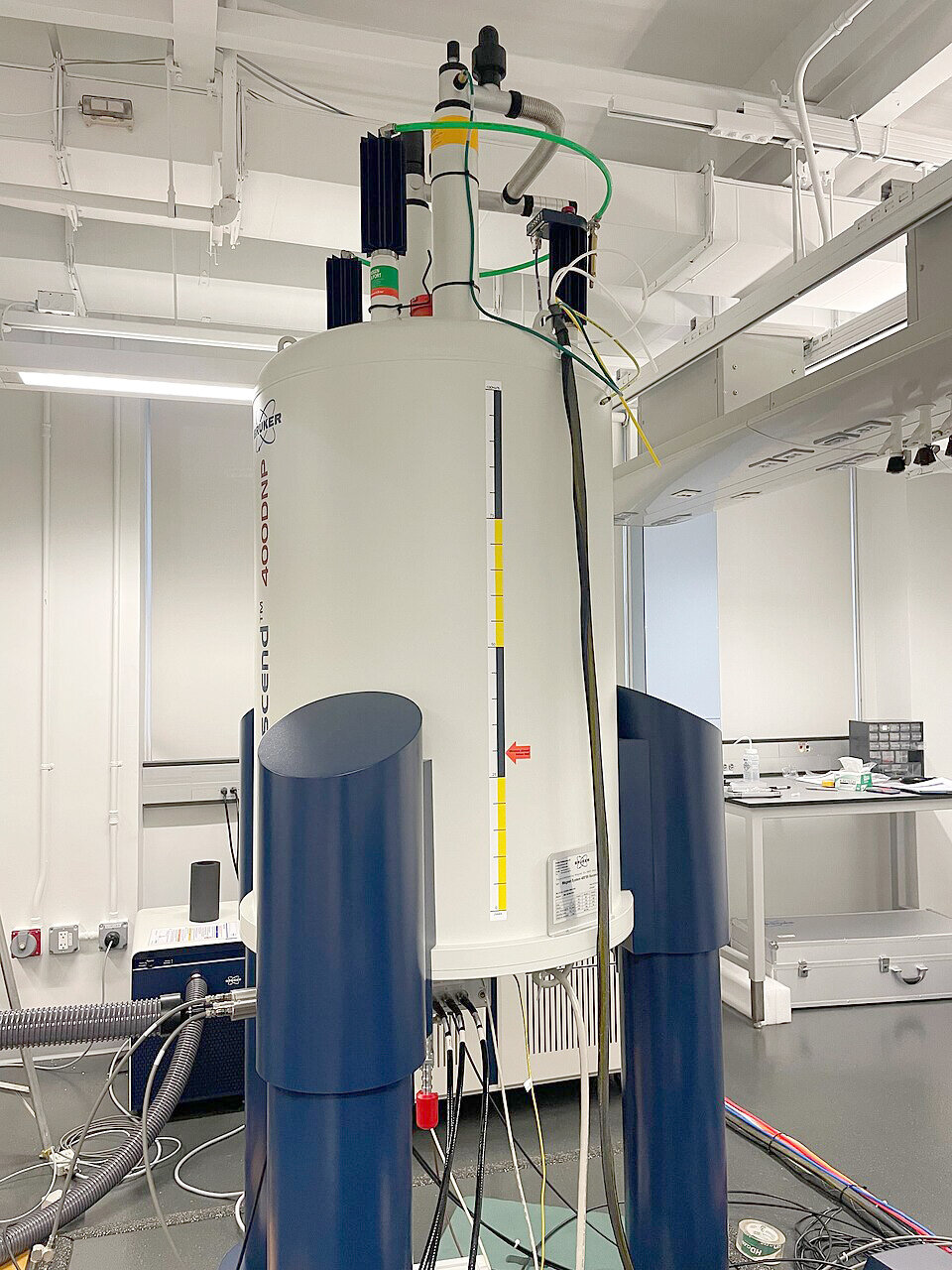
Image title: Nuclear magnetic resonance spectroscopy instrumentation
Image caption: The researchers utilized NMR measurements to track signal intensity and relaxation dynamics inside the organic conductor, uncovering the thermal self-organization and current filament formation driven by Joule heating.
Image credit: SamihaAlam1999 from Wikimedia Commons
Image link: https://commons.wikimedia.org/wiki/File:NMR_instrument.jpg
License type: CC BY-SA 4.0
Usage restrictions: Credit must be given to the creator. Adaptations must be shared under the same terms.
Reference
| Title of original paper | : | Volatile resistive-switched state in a bulk organic conductor with a sharp metal-insulator transition |
| Journal | : | Physical Review Applied |
| DOI | : | 10.1103/3yjz-8f9d |
About The Tokyo University of Science
Tokyo University of Science (TUS) is a well-known and respected university, and the largest science-specialized private research university in Japan, with four campuses in central Tokyo and its suburbs and in Hokkaido. Established in 1881, the university has continually contributed to Japan's development in science through inculcating the love for science in researchers, technicians, and educators.
With a mission of "Creating science and technology for the harmonious development of nature, human beings, and society," TUS has undertaken a wide range of research from basic to applied science. TUS has embraced a multidisciplinary approach to research and undertaken intensive study in some of today's most vital fields. TUS is a meritocracy where the best in science is recognized and nurtured. It is the only private university in Japan that has produced a Nobel Prize winner and the only private university in Asia to produce Nobel Prize winners within the natural sciences field.
■
Tokyo University of Science(About TUS)
About Professor Tetsuaki Itou
from Tokyo University of Science
Dr. Tetsuaki Itou is currently a Professor in the Department of Applied Physics at Tokyo University of Science. He received his bachelor's, master's, and Ph.D. degrees in engineering from The University of Tokyo. An active member of the Physical Society of Japan, he was awarded its prestigious Young Scientist Award in 2011. His primary research interests focus on condensed matter physics, including magnetism, unconventional superconductivity, and strongly correlated electron systems such as molecular conductors. To date, Dr. Itou has published over 30 peer-reviewed articles in leading academic journals, earning more than 1,400 citations for his contributions to the field.
Funding information
This work was supported in part by KAKENHI (Grant Nos. 22H01184, 19H01852, and 18H05225) from Japan Society for the Promotion of Science (JSPS), and Japan Science and Technology Agency (JST) CREST (Grant No. JP-MJCR23A1), Japan.