2026.08.03 Monday
Watching comedy helps people detect faint smiles,
a new study shows
Researchers examine how positive moods induced by comedy viewing can help improve facial expression recognition

In everyday life, the ability to read facial expressions plays a vital role in social communication, as it reveals a speaker's underlying emotions, intentions, and psychological state. More importantly, accurately recognizing subtle signs of positive emotions can help build trust, enhance cooperation, and strengthen relationships. In this context, previous research has shown that facial expression recognition can be influenced by the observer's emotional state. For example, people who are happy or in a positive mood tend to interpret facial expressions more positively than those in a negative mood. This phenomenon is linked to the mood-congruent memory effect, in which people are more likely to remember past events in accordance with their current mood.
This effect can also be influenced by a person's individual emotional traits, such as depression or empathy. Some studies have shown that people with depression often have greater difficulty in recognizing happy facial expressions. Furthermore, the ability to recognize facial expressions can also be hindered by obstructions that hide key facial features, such as masks that cover much of the lower half of the face.
To explore these links, a research team led by Professor Hiroko Ichikawa from Institute of Arts and Sciences, Tokyo University of Science (TUS), Japan, and Lecturer Asami Oguro-Ando from University of Exeter Medical School, University of Exeter, United Kingdom, investigated how individuals in a positive emotional state perceive happy facial expressions compared to when they are in a neutral emotional state. "In daily life, facial expressions are not always clear. There are situations where it is important to be able to recognize a faint smile or similar subtle changes in expression," explains Prof. Ichikawa. "Moreover, the mood and individual emotional tendencies of the person reading the expressions are also important. In this study, we thoroughly examined these relationships and also examined whether this relationship changes when key facial cues are hidden by a mask, which became an important part of everyday life and social interaction during the COVID-19 pandemic."
The team included master's students Keisuke Adachi and Miyu Kashiwa, who completed their master's degrees from the Department of Biological Science and Technology, Faculty of Advanced Engineering, TUS, along with Lecturer Asami Oguro-Ando from the University of Exeter Medical School, University of Exeter, United Kingdom; Professor Masato Okada from the Graduate School of Frontier Sciences, The University of Tokyo, Japan; and Dr. Masami Shimizu, who completed his doctoral degree at the same graduate school in 2025. Their study was published in the journal Scientific Reports on July 20, 2026.
Fifty-three adults, 22 men and 31 women, participated in the study. Each participant watched either a comedy video or a neutral weather forecast for 20 minutes. Comedy videos have been shown to help alleviate negative emotions and enhance positive emotions, particularly during the COVID-19 pandemic. As such, a comedy video was used as a tool to induce positive emotions in the participants. The researchers first assessed the difference in mood states of the participants after watching the two videos to confirm whether the mood manipulation worked. Participants who watched the comedy video reported significantly higher scores on positive mood scales as compared to those who watched the weather forecast video.
Next, they examined how watching a comedy video influenced the participants' ability to recognize subtle positive facial expressions without a facial mask. The results showed that participants were more likely to correctly identify subtle positive expressions after watching the comedy video than after watching the weather forecast. In contrast, there was no difference between the two conditions in recognizing negative expressions, consistent with previous research. These findings suggest that inducing positive emotions through comedy viewing can help improve recognition of subtle positive facial expressions.
Notably, this mood-congruency effect was absent for faces wearing masks. This is likely because masks alter the overall impression of the face by obscuring the mouth and surrounding areas, which provide important visual cues for recognizing smiles. Moreover, masked faces may create greater uncertainty about facial expressions, making people less likely to project their own emotional state onto others.
The researchers also examined how individual differences, such as depressive symptoms and empathy traits, moderate these mood-congruency effects. Higher perspective taking (PT), an important component of empathy, was most strongly linked with the improvement in facial expression recognition following the comedy video. Interestingly, they also found that even a temporary reduction in depressive mood, immediately after watching a comedy video, can help increase sensitivity to subtle positive facial expressions.
"Our findings highlight the importance of considering personality and mood-related factors when studying facial expression recognition," remarks Lecturer Oguro-Ando. "Understanding how mood influences the interpretation of facial expressions can help establish methods to ensure smoother communication in situations where understanding people's emotions is crucial, such as in education, welfare, healthcare, and the workplace."
Overall, the findings provide new insight into how a person's mood influences the recognition of subtle facial expressions, suggesting that even brief positive experiences, such as watching a comedy video, may improve sensitivity to faint smiles under some circumstances.
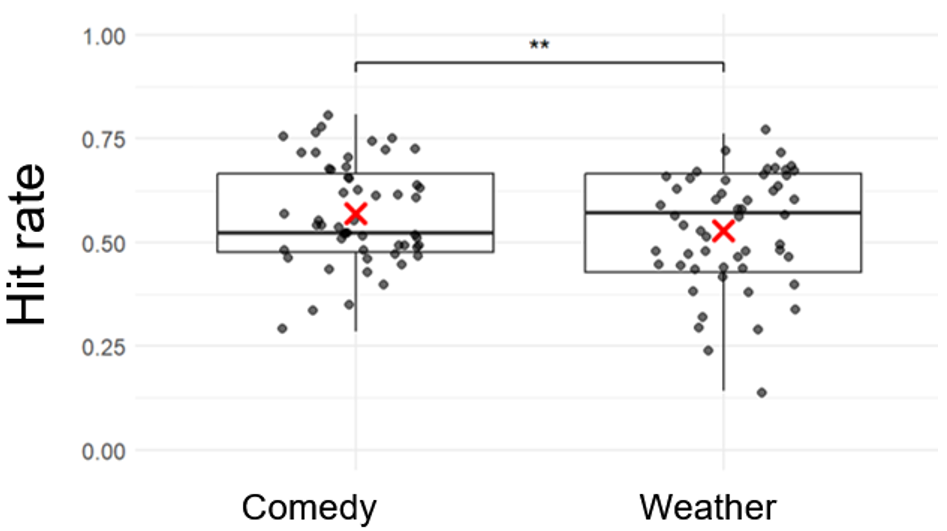
Image title: Comparison of recognition rate for subtle smiles on unmasked faces between two conditions
Image caption: Participants who viewed the comedy video were more likely to accurately recognize subtle positive facial expressions, offering important insights into how a person's mood influences the recognition of subtle facial expressions.
Image credit: Professor Hiroko Ichikawa from Tokyo University of Science, Japan, and Lecturer Asami Oguro-Ando from University of Exeter Medical School, University of Exeter, United Kingdom
Image source link: https://www.nature.com/articles/s41598-026-59955-0
License type: CC BY 4.0
Usage restrictions: Credit must be given to the creator.

Image title: How a person's mood influences ability to recognize facial expressions
Image caption: The findings show that positive mood states can enhance a person's sensitivity to subtle positive facial expressions. Individual traits and the use of face masks can also moderate this effect.
Image credit: "Group of people talking" by UNE Photos from Openverse
Image source link: https://openverse.org/image/d28caaa9-4d3d-4cee-82fd-2bd21f025060?q=Group+of+people+talking&p=5
License type: CC BY 2.0
Usage restrictions: Credit must be given to the creator.
Reference
| Title of original paper | : | Subtle Positive Facial Expression Recognition is Enhanced by Comedy Viewing: Individual Differences in Empathy and Depressive Tendencies |
| Journal | : | Scientific Reports |
| DOI | : | 10.1038/s41598-026-59955-0 |
| Authors | : | Keisuke Adachi1, Miyu Kashiwa1, Masaumi Shimizu2, Masato Okada2, Asami Oguro-Ando3,4*, and Hiroko Ichikawa1* |
| Affiliations | : | 1Graduate School of Science and Technology, Tokyo University of Science, Japan 2Graduate School of Frontier Sciences, The University of Tokyo, Japan 3University of Exeter Medical School, University of Exeter, United Kingdom 4Faculty of Pharmaceutical Sciences, Tokyo University of Science, Japan *These authors are co-corresponding authors. |
About The Tokyo University of Science
Tokyo University of Science (TUS) is a well-known and respected university, and the largest science-specialized private research university in Japan, with four campuses in central Tokyo and its suburbs and in Hokkaido. Established in 1881, the university has continually contributed to Japan's development in science through inculcating the love for science in researchers, technicians, and educators.
With a mission of "Creating science and technology for the harmonious development of nature, human beings, and society," TUS has undertaken a wide range of research from basic to applied science. TUS has embraced a multidisciplinary approach to research and undertaken intensive study in some of today's most vital fields. TUS is a meritocracy where the best in science is recognized and nurtured. It is the only private university in Japan that has produced a Nobel Prize winner and the only private university in Asia to produce Nobel Prize winners within the natural sciences field.
■
Tokyo University of Science(About TUS)
About Professor Hiroko Ichikawa
from Tokyo University of Science
Dr. Hiroko Ichikawa is a Professor in the Institute for Liberal Arts Education at Noda Campus, Tokyo University of Science. She received her Ph.D. in Behavioral Science from the University of Tsukuba in 2008. Her research interests include experimental psychology, science education studies using eye-tracking methods, face perception and facial expression recognition using electroencephalogram and eye-tracking methods, and the psychophysiology of stress. She has authored more than 30 publications and is a member of several academic societies, including the Japanese Psychonomic Society.
Funding information
This research was funded by the Tokyo University of Science Research Grants.