2026.07.28 Tuesday
AI-Designed Metamaterials Pave the Way for High-Speed Spin-Wave Computing
A new approach for optimizing magnonic crystal design using inverse design has discovered nontrivial but high-performing magnetic nanostructures

Spin waves (SWs), or magnons, are collective excitations of magnetization in magnetic materials arising from electron spins. They have attracted considerable attention as information carriers and have shown promise in logic circuits, memory devices, and physical neural networks. Among the emerging platforms for manipulating SWs are magnonic crystals (MCs), engineered magnetic materials with periodic structures designed to control magnon propagation. These periodic structures give rise to magnonic band structures and mode profiles, much like semiconductor crystals control electron transport.
Designing magnonic band structures for specific applications requires precise control over the geometry of patterned magnetic materials. Among the various geometrically engineered features of MCs, magnonic band gaps (MBGs), where SWs cannot propagate at specific excitation frequencies, have become central design targets as they are highly tunable and relatively easy to characterize experimentally. However, establishing general design strategies for optimizing targeted properties in MCs has proved challenging, mainly because of the intricate relationship between lattice geometry and magnonic dispersions. Moreover, most previous studies have focused primarily on lower-order bands, since higher-order bands are more sensitive to geometric modifications and are therefore more difficult to predict and control.
To address these challenges, a research team led by Professor Masato Kotsugi, together with second-year doctoral student Ryunosuke Nagaoka from the Department of Materials Science and Technology at Tokyo University of Science (TUS), Japan, developed and demonstrated an inverse-design framework for two-dimensional MCs "The inverse-design approach is a promising strategy for efficiently exploring optimal structures, where desired properties are defined as objective functions and parametrized design regions are optimized through machine learning or mathematical optimization methods," explains Prof. Kotsugi. "This approach significantly expands the design space, allowing us to explore unconventional lattice structures with large MBGs." Their findings were published in the journal Small Structures on July 28, 2026.
The researchers focused on identifying previously unexplored MC designs with the widest complete MBGs (CMBGs). To this end, they employed inverse-design topology optimization of 2D MCs by combining frequency-domain micromagnetic simulations based on the frequency-domain Landau-Lifshitz-Gilbert (FD-LLG) equation with a genetic algorithm (GA) for global optimization.
Because maximizing the CMBG was the target property, it was defined as the objective function and evaluated using FD-LLG simulations. The LLG equation governs magnetization dynamics at the nanometer scale. Compared with conventional time-domain micromagnetic simulations, which typically require long computation times, FD-LLG simulations enable more efficient and reliable evaluation of magnonic band structures. This computational efficiency is important for inverse design, where many candidate structures must be screened before a promising one is found.
In the proposed inverse-design framework, the material distribution in a unit cell of a target MC, in this case a bicomponent MC composed of europium oxide and iron, is first represented by a binary vector for the GA. The resulting band gaps are then evaluated using FD-LLG simulations, after which GA operations generate the next population. New binary-vector arrays are subsequently created, redefining the unit-cell structures for the next iteration. These four steps are repeated iteratively, gradually transforming the unit-cell structure toward designs with larger band gaps. Ultimately, the optimization converges on a non-intuitive topology that differs substantially from conventional geometrical designs.
Results revealed topology-optimized structures with significantly improved CMBGs compared with conventional structures, with the structure optimized for the gap between the fourth and fifth bands exhibiting the largest band gap. To clarify the underlying design principles, the researchers applied a modified version of their previously developed explainable machine learning framework to visualize the design landscape. This analysis showed that the design landscape becomes increasingly non-convex at higher-order bands, suggesting that multiple design solutions may exist.
These results also point to broader applications in energy-efficient spintronic devices and green computing, with potential relevance to future data-center hardware. In addition, the findings on higher-order bands may support multi-frequency signal processing and faster spin-wave-based communication.
"This inverse-design framework can be broadly applied to experimentally accessible material systems and device dimensions, enabling the development of design rules for MCs," remarks Prof. Kotsugi. "Topology-optimized 2D MCs may open the pathway for MC designs with greater flexibility, beyond what can be achieved through conventional structural design," he concludes.
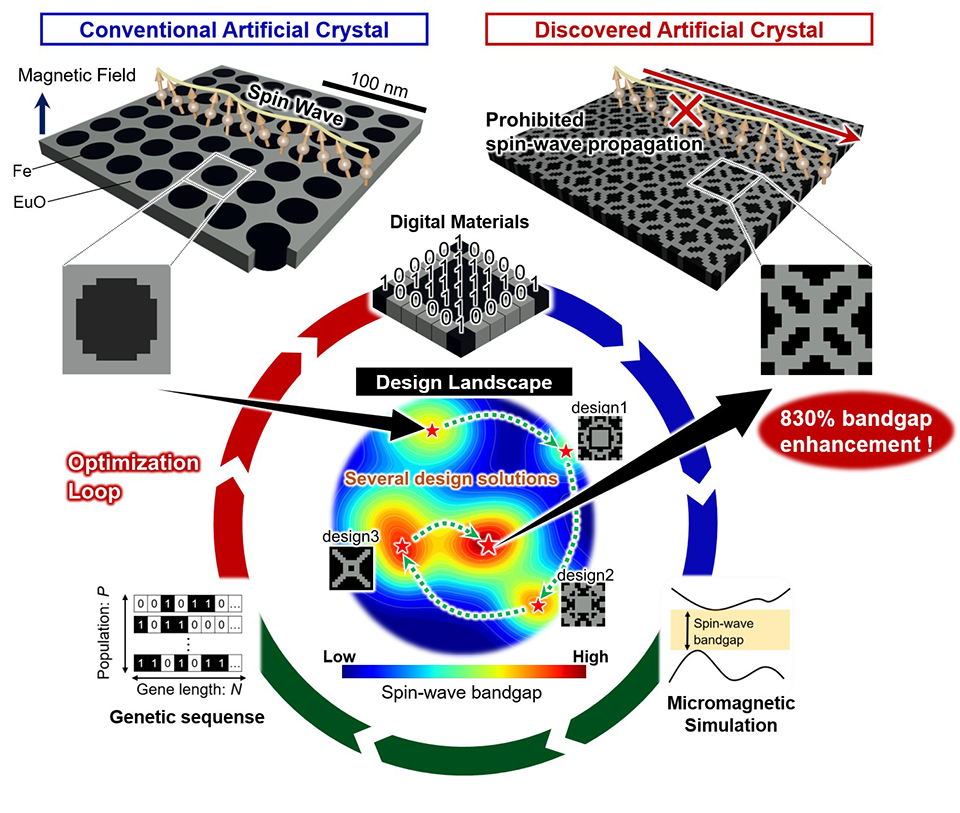
Image title: Schematic image for design exploration of magnonic crystals
Image caption: The proposed inverse-design approach enables the exploration of unconventional magnonic crystal (MC) structures with large band gaps, helping to formulate design rules for MCs.
Image credit: Professor Masato Kotsugi from Tokyo University of Science, Japan
License type: Original content
Usage restrictions: Cannot be reused without permission
Reference
| Title of original paper | : | Inverse design of two-dimensional magnonic crystals via topology optimization with frequency-domain micromagnetics |
| Journal | : | Small Structures |
| DOI | : | 10.1002/sstr.70526 |
About The Tokyo University of Science
Tokyo University of Science (TUS) is a well-known and respected university, and the largest science-specialized private research university in Japan, with four campuses in central Tokyo and its suburbs and in Hokkaido. Established in 1881, the university has continually contributed to Japan's development in science through inculcating the love for science in researchers, technicians, and educators.
With a mission of "Creating science and technology for the harmonious development of nature, human beings, and society," TUS has undertaken a wide range of research from basic to applied science. TUS has embraced a multidisciplinary approach to research and undertaken intensive study in some of today's most vital fields. TUS is a meritocracy where the best in science is recognized and nurtured. It is the only private university in Japan that has produced a Nobel Prize winner and the only private university in Asia to produce Nobel Prize winners within the natural sciences field.
■
Tokyo University of Science(About TUS)
About Professor Masato Kotsugi
from Tokyo University of Science
Professor Masato Kotsugi graduated from Sophia University, Japan, in 1996, and subsequently received his Ph.D. from the Graduate School of Engineering Science at Osaka University, Japan, in 2001. He joined Tokyo University of Science in 2015 as a lecturer and is now a Professor at the Faculty of Advanced Engineering, Department of Materials Science and Technology. Prof. Kotsugi and his students conduct cutting-edge research on high-performance materials to create a green energy society. He has published over 160 peer-reviewed papers and is currently interested in solid-state physics, magnetism, synchrotron radiation, and materials informatics.
Funding information
This work was supported by Grant-in-Aid for JSPS Fellows, DC1 (Nos. 25KJ2117) to Ryunosuke Nagaoka. Part of this study was supported by JST ACT-X (Nos. JPMJAX22AL) to Takahiro Yamazaki and JST CREST (Nos. JPMJCR21O1) to Masato Kotsugi and Yuma Iwasaki.