2026.07.06 Monday
Researchers Discover a Smarter Way to Solve Vehicle Routing Problems Using Adaptive Swarm Learning
Recent study proposes a novel approach that improves stability and solution quality of chaotic search algorithms to solve optimization problems

Combinatorial optimization problems are encountered often in various real-world applications, including logistics, scheduling, and network design. These problems involve finding the best possible solution from a finite set of discrete options by maximizing or minimizing an objective function subject to specified constraints. In such problems, the number of feasible solutions increases exponentially with the problem size, making it nearly impossible to find optimal solutions. To tackle these problems, many heuristic and metaheuristic algorithms have been developed to efficiently obtain approximate solutions.
Chaotic search (CS) is among such algorithms that utilize chaotic dynamics to search for solutions. Chaotic dynamics follow precise rules but can appear unpredictable due to their extreme sensitivity to minuscule changes in initial parameters. Unlike purely stochastic methods, CS generates deterministic yet highly irregular search trajectories that can promote thorough exploration of the solution space. This approach can help the search process avoid becoming trapped in local solutions.
Despite its strong global exploration ability, the performance of CS algorithms is highly sensitive to several control parameters. When the parameters match a problem's characteristics, CS works well, but even a slight mismatch can lead to unstable behavior. To improve robustness, researchers have previously extended the CS method with a parameter-tuning approach (CST), introducing heuristic feedback mechanisms. However, in CST, all parameters are uniformly updated according to global statistics, limiting adaptability and stability in complex problems.
To overcome these limitations, a research team led by Professor Tohru Ikeguchi from the Faculty of Engineering at Tokyo University of Science (TUS), Japan, proposed a new learning-based adaptive tuning method that integrates CS with particle swarm optimization (CSPSO). The team included third-year doctoral student Mr. Fengkai Guo from TUS, Associate Professor Takafumi Matsuura from Nippon Institute of Technology, and Professor Takayuki Kimura from Tokyo City University, Japan. Their study was published in Nonlinear Theory and Its Applications, IEICE (NOLTA), on July 01, 2026.
"In Particle Swarm Optimization (PSO), which draws inspiration from flocks of birds and ant colonies, a group of particles—referred to as a "swarm"—moves collectively through the search space, converging on promising regions while maintaining diversity," explains Prof. Ikeguchi. "Owing to its relatively simple implementation and computational efficiency, PSO has been applied to many optimization problems. In our approach, PSO is utilized to dynamically control parameters of the chaotic neural network during searching, enhancing solution quality and robustness."
In the proposed CSPSO approach, parameter tuning of CS is achieved externally using PSO. First, a swarm of particles, where each particle represents a candidate parameter vector, is initialized. For each particle, CS is performed, and the fitness of each particle is evaluated based on the obtained solution at the end of the run. Next, PSO updates each particle based on the fitness results. These steps are repeated until a specific condition is satisfied.
This iterative interaction essentially forms a two-layer optimization framework where the outer PSO layer efficiently and adaptively tunes parameters, thereby regulating the strength of the chaotic excitation, while the inner CS layer improves the solution using the parameters. By continuously adapting the parameters during the search process, the framework aims to maintain useful chaotic activity while promoting stable convergence.
The researchers tested the CSPSO method on capacitated vehicle routing problems (CVRP), a fundamental logistics optimization problem in which a fleet of vehicles must serve customers with known demands while respecting vehicle capacity limits. The results showed that CSPSO consistently achieved better solution quality and higher robustness compared with conventional CS and CST methods.
Notably, the algorithm remained stable over a wide range of PSO settings. Although CSPSO required more computational time than CST, the researchers point out that it is not easy to configure the parameters of chaotic neural networks in conventional CS and CST to achieve efficient search. Furthermore, given the enormous computational cost of exhaustively searching the parameter space, CSPSO offers a practical means of improving the performance of CS and CST.
"In CSPSO, swarm-based learning absorbs the parameter tuning burden, reducing the need for careful manual calibration," remarks Prof. Ikeguchi. "It provides an effective enhancement technique for CS, making it more flexible and adaptive to different scenarios, including shift scheduling, factory production planning and information technology networks."
This approach could improve the efficiency and robustness of optimization methods used in applications such as logistics, transportation, and scheduling.
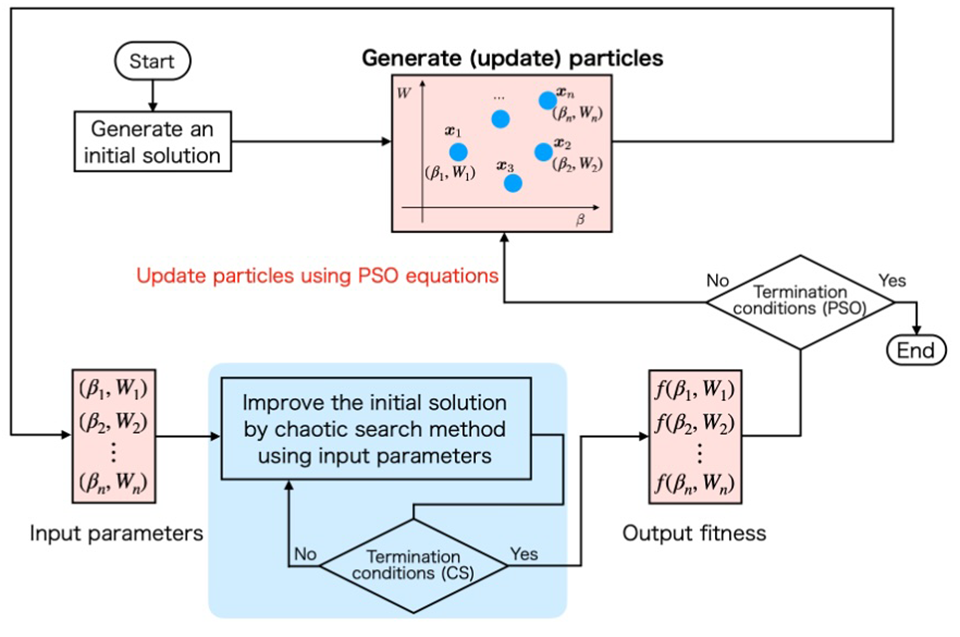
Image title: Proposed chaotic search with particle search optimization
Image caption: The proposed approach forms a two-layer optimization framework: the outer particle swarm optimization layer handles parameter tuning, while the inner chaotic search improves the solution using the tuned parameters.
Image credit: Professor Tohru Ikeguchi from Tokyo University of Science, Japan
Source link: https://www.jstage.jst.go.jp/article/nolta/17/3/17_1062/_article
License type: CC-BY-NC-ND 4.0
Usage restrictions: Credit must be given to the creator. Only noncommercial uses of the work are permitted. No derivatives or adaptations of the work are permitted.
Reference
| Title of original paper | : | Adaptive parameter tuning of chaotic search using particle swarm optimization |
| Journal | : | Nonlinear Theory and Its Applications, IEICE (NOLTA) |
| DOI | : | 10.1587/nolta.17.1062 |
About The Tokyo University of Science
Tokyo University of Science (TUS) is a well-known and respected university, and the largest science-specialized private research university in Japan, with four campuses in central Tokyo and its suburbs and in Hokkaido. Established in 1881, the university has continually contributed to Japan's development in science through inculcating the love for science in researchers, technicians, and educators.
With a mission of "Creating science and technology for the harmonious development of nature, human beings, and society," TUS has undertaken a wide range of research from basic to applied science. TUS has embraced a multidisciplinary approach to research and undertaken intensive study in some of today's most vital fields. TUS is a meritocracy where the best in science is recognized and nurtured. It is the only private university in Japan that has produced a Nobel Prize winner and the only private university in Asia to produce Nobel Prize winners within the natural sciences field.
■
Tokyo University of Science(About TUS)
About Professor Tohru Ikeguchi
from Tokyo University of Science
Dr. Tohru Ikeguchi is a Professor at the Department of Information and Computer Technology at the Tokyo University of Science (TUS), Japan. He received his B.E., M.E., and D.E. degrees from TUS. After working for nearly a decade as a full-time Professor at Saitama University, Japan, he served in TUS's Department of Management Science from 2014 to 2016 before joining his current department. His research interests include nonlinear time series analysis, computational neuroscience, the application of chaotic dynamics to solving combinatorial optimization problems, and complex network theory. He has published over 230 papers and proceedings and refereed over 140 papers.
Funding information
The work was supported by JSPS KAKENHI (grant numbers: 20H00596, 22K04602, 22K18419, 23K04274, 23K21706, 25H00447, 25K08182) and by the Cooperative Research Projects of the Research Institute of Electrical Communication, Tohoku University (project numbers: R05/A19, R05/B13, and R06/B02).