2026.07.07 Tuesday
First Bulk Ferromagnetic Icosahedral Quasicrystals Synthesized without Rapid Quenching
The first bulk, annealable ferromagnetic quasicrystals enable systematic investigations of quasiperiodic magnetism and magnetic criticality
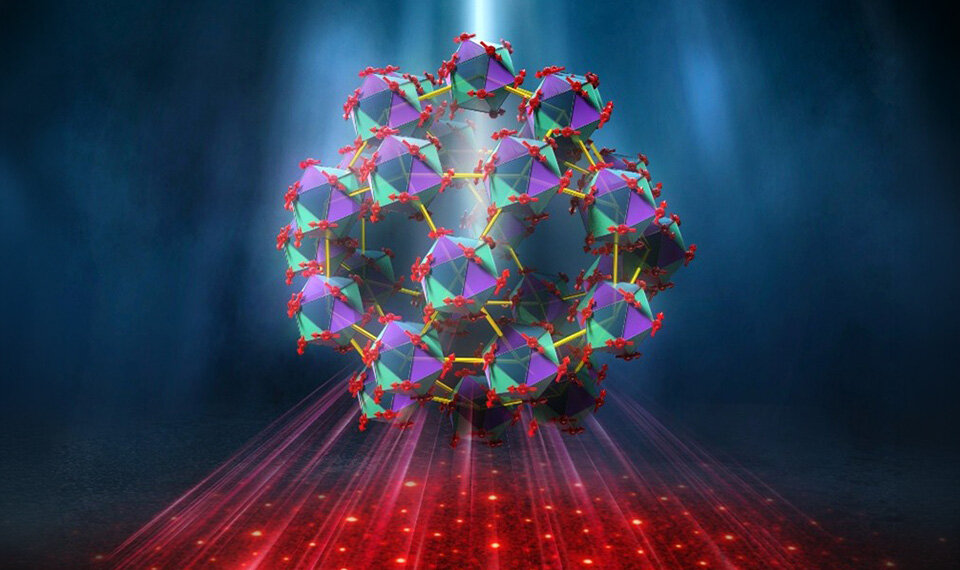
Ferromagnetism has long been studied in a wide range of periodic crystals and amorphous materials. In quasicrystals (QCs), which possess long-range quasiperiodic order and unconventional rotational symmetries, such as ten-fold symmetry, ferromagnetism remained elusive until recently, when it was finally realized in gold (Au)-based icosahedral QCs. These discoveries establish QCs as a third platform for magnetism beyond periodic crystals and amorphous materials.
To date, ferromagnetic QCs have only been synthesized through rapid quenching, making them metastable and structurally imperfect scaffolds for detailed investigations of their intrinsic magnetic properties. Upon annealing, QCs transform into approximant crystals, closely related phases to QCs that share the same local atomic structure but possess periodic order. Owing to these limitations, intrinsic magnetic properties, particularly magnetic criticality, which describes the behavior of a material near a magnetic phase transition, have not yet been fully characterized in QCs. Addressing these questions requires bulk ferromagnetic QCs with high structural coherence and thermal stability.
In a breakthrough study, a research team led by Professor Ryuji Tamura from the Department of Materials Science and Technology and Dr. Farid Labib from the Research Institute of Science and Technology at Tokyo University of Science (TUS), Japan, has, for the first time, successfully developed bulk, annealable ferromagnetic icosahedral QCs without rapid quenching. "Using compositionally tuned multicomponent alloying and guided by a machine-learning-based phase classifier, we developed ferromagnetic icosahedral QCs with unprecedented structural quality, enabling the first systematic investigations of intrinsic magnetic properties, including critical behavior, in QCs," explains Prof. Tamura. Their study was published online in the Journal of the American Chemical Society on July 7, 2026.
To identify favorable compositions for ferromagnetic icosahedral QCs, the researchers first employed a machine-learning-based phase classifier. Using the QC database HYPOD-X, along with other existing databases, the algorithm predicted candidate compositions for stable ferromagnetic icosahedral QCs. In total, 675 quinary alloy systems were generated. Among these, gold-copper-aluminum-indium-R (Au-Cu-Al-In-R) systems, where R represents either gadolinium (Gd), terbium (Tb), or dysprosium (Dy), emerged as the most promising candidates. The researchers subsequently synthesized three bulk quinary ferromagnetic icosahedral QCs, Au-Cu-Al-In-Gd, Au-Cu-Al-In-Tb, and Au-Cu-Al-In-Dy, using conventional arc melting followed by controlled annealing.
Long-time annealing of the newly synthesized icosahedral QCs at 723 Kelvin provided direct evidence that these QCs remain stable during prolonged annealing at elevated temperatures. As a result, X-ray diffraction studies revealed a significant improvement in quasiperiodic order compared to previously reported ferromagnetic QCs produced through rapid quenching.
Magnetic and specific heat assessments demonstrated clear bulk long-range ferromagnetic order within a temperature range of 9.7 ̶ 28.3 Kelvin, depending on the constituent R element (i.e., Gd, Tb, and Dy), providing clear evidence of intrinsic ferromagnetic order in these newly discovered QCs.
Interestingly, despite sharing an identical quasiperiodic lattice, the three compounds exhibited two markedly distinct types of magnetic critical behavior depending on the single-ion magnetic anisotropy of the R element. Specifically, Tb- and Dy-based icosahedral QCs showed critical parameters close to mean-field values, indicating mean-field-like ferromagnetism characterized by infinitely long-range interactions. In contrast, the Gd-based icosahedral QCs demonstrated a clear deviation from mean-field behavior toward shorter-range interactions. Such a distinction was made possible by the exceptional structural coherence of these newly synthesized QCs. The team attributed this difference in behavior to stronger spin fluctuations in the Gd system, where magnetic moments are less restricted in their motion and can fluctuate more easily. The results suggest that strong magnetic anisotropy in the Tb- and Dy-based systems suppresses spin fluctuations, leading to behavior closer to the mean-field model.
"These results indicate that magnetic criticality in QCs is determined by the combination of quasiperiodic order and spin symmetry," remarks Prof. Tamura. "Understanding how quasiperiodicity influences magnetic fluctuations may ultimately enable the design of materials with tunable magnetic responses, potentially benefiting future sensing, energy-conversion, and information-processing technologies."
Overall, this study provides important new insights into the magnetic criticality of QCs, revealing how quasiperiodic order and spin symmetry together influence magnetic phase transitions.
More broadly, this work transforms ferromagnetic QCs from rapidly quenched metastable phases into a new class of bulk magnetic materials that can be synthesized, annealed, and systematically investigated. The availability of high-quality bulk ferromagnetic QCs opens the door to exploring their intrinsic physical properties and establishes a new materials platform for future magnetic and quantum functional materials.
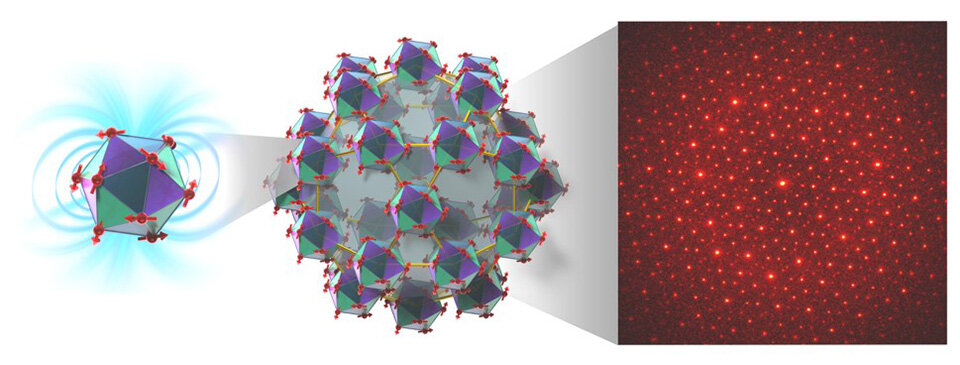
Image title: First bulk ferromagnetic icosahedral quasicrystals
Image caption: (left) An isolated icosahedron with whirling moment configuration, (middle) whirling magnetic configurations on a network of rare-earth icosahedra, (right) electron diffraction pattern showing sharp reflections and exceptional quasiperiodic coherence in the first bulk, annealable ferromagnetic icosahedral quasicrystal.
Image credit: Professor Ryuji Tamura from TUS, Japan
License type: Original content
Usage restrictions: Cannot be reused without permission
Reference
| Title of original paper | : | Bulk Ferromagnetic Icosahedral Quasicrystals without Rapid Quenching |
| Journal | : | Journal of the American Chemical Society |
| DOI | : | 10.1021/jacs.6c03748 |
About The Tokyo University of Science
Tokyo University of Science (TUS) is a well-known and respected university, and the largest science-specialized private research university in Japan, with four campuses in central Tokyo and its suburbs and in Hokkaido. Established in 1881, the university has continually contributed to Japan's development in science through inculcating the love for science in researchers, technicians, and educators.
With a mission of "Creating science and technology for the harmonious development of nature, human beings, and society," TUS has undertaken a wide range of research from basic to applied science. TUS has embraced a multidisciplinary approach to research and undertaken intensive study in some of today's most vital fields. TUS is a meritocracy where the best in science is recognized and nurtured. It is the only private university in Japan that has produced a Nobel Prize winner and the only private university in Asia to produce Nobel Prize winners within the natural sciences field.
■
Tokyo University of Science(About TUS)
About Professor Ryuji Tamura
from Tokyo University of Science
Professor Ryuji Tamura is a leading materials scientist at the Tokyo University of Science, where he serves in the Faculty of Advanced Engineering, Department of Materials Science and Technology. A specialist in quasicrystals, approximant crystals, and metallic materials, Prof. Tamura has authored over 180 refereed papers and received numerous accolades, including the prestigious Jean-Marie Dubois Award in 2025. His research focuses on synthesizing novel quasiperiodic materials and exploring their structural and magnetic properties. He heads the Tamura Laboratory, which pioneers the study of "hypermaterials," that extends beyond traditional crystallography.
About Professor Farid Labib
from Tokyo University of Science
Funding information
This work was supported by the Japan Society for the Promotion of Science through Grants-in-Aid for Scientific Research (Grant Nos. JP19H05817, JP19H05818, JP19H05819, JP21H01044 and JP24K17016) and by JST, CREST (Grant No. JPMJCR22O3), Japan.