2026.06.09 Tuesday
How Healthcare Systems Shape Native Preferences for Immigrants
Study shows that the perception of immigrants' participation in the healthcare system may increase public preferences for high-income immigrants

In recent years, anti-immigration sentiment has become increasingly common around the world. A common concern surrounding immigration is its potential impact on the host country's welfare system, including healthcare. Such concerns can reduce public support for accepting immigrants and for redistributive welfare policies. When immigrants are included in a welfare system, natives may prefer immigrants with higher incomes because they are seen as contributing more to that system. This preference may arise not from hostility toward immigrants or fears of welfare abuse, but from economic self-interest.
These preferences can have important implications for immigration policy design. Although previous studies have examined this issue, they had two major limitations. First, they do not establish a causal link between preferences for immigrant types and concerns that they could become welfare burdens. Second, these studies mostly focus on fears that low-income immigrants could become welfare burdens, when the mere inclusion of immigrants in the welfare system may increase preferences for higher-income immigrants.
To address these gaps, Associate Professor Tomoko Matsumoto from the Institute of Arts and Sciences, Tokyo University of Science, Japan, along with Associate Professor Daiki Kishishita from the Graduate School of Economics, Hitotsubashi University, Japan, developed a novel conjoint survey experiment. "To examine how perceptions of immigrants' relationship to the welfare system affect public preferences for different types of immigrants, we designed a new approach combining an information-provision experiment with a conjoint survey experiment," explains Dr. Matsumoto. Their findings were published online in the journal Public Choice on June 01, 2026.
The researchers conducted an online survey experiment in Japan involving approximately 2,000 respondents. Before beginning the study, they proposed three hypotheses.
The first hypothesis suggested that people would generally prefer younger immigrants, immigrants with higher incomes, and those working in the nursing industry. The researchers also expected respondents to favor immigrants from Western or Asian countries and from democratic and developed nations over those from authoritarian or developing countries.
The second and main hypothesis proposed that informing people about immigrants' participation in Japan's healthcare insurance system would reduce support for low-income immigrants while increasing support for high-income immigrants, without substantially affecting preferences for other attributes.
The third hypothesis suggested that preferences for high- and low-income immigrants would mainly occur among those who do not have job security concerns.
In the survey, participants first completed a reCAPTCHA verification and attention-check questions, followed by questions about their demographic background and perceptions of job security. They were then randomly assigned to either a control group or a treatment group.
Participants in the control group received information about labor shortages in Japan and the role of foreign workers in addressing these shortages. The treatment group received the same information, along with additional information explaining that immigrants also participate in and contribute to Japan's healthcare system.
After reading this information, the participants completed a conjoint survey experiment, where they answered questions about the acceptance of hypothetical foreign workers in Japan based on attributes such as income, age, industry, the political regime of the origin country, whether their origin country is developed or developing, and the region of origin. The mean values of these attributes were compared between the two groups.
The researchers found that in the control group, only about half of the respondents correctly understood that foreign workers are covered by Japan's national healthcare system. In the treatment group, this understanding increased by around 30%, verifying that the information treatment successfully improved awareness of immigrants' participation in the healthcare system.
The findings largely supported the first hypothesis, with one notable exception. In the control group, the respondents preferred low-income immigrants over high-income immigrants in the context of addressing labor shortages.
However, the responses from the treatment group supported the second hypothesis, without affecting their preferences for other attributes. This suggests that the inclusion of immigrants in the welfare system shifts public preferences towards high-income immigrants.
The results also supported the third hypothesis, indicating that concerns about welfare systems and job security may jointly interact while shaping attitudes toward immigration.
"Previous research mostly explores how immigration influences welfare-state institutions, but our study demonstrates the opposite: existing institutional design itself shapes immigration preferences and ultimately immigration policy," remarks Dr. Matsumoto. "By establishing this causal link, we open an important avenue for future research."
Overall, this work offers important insights into how welfare systems shape public preferences for different types of immigrants and how these perceptions may influence immigration policy.
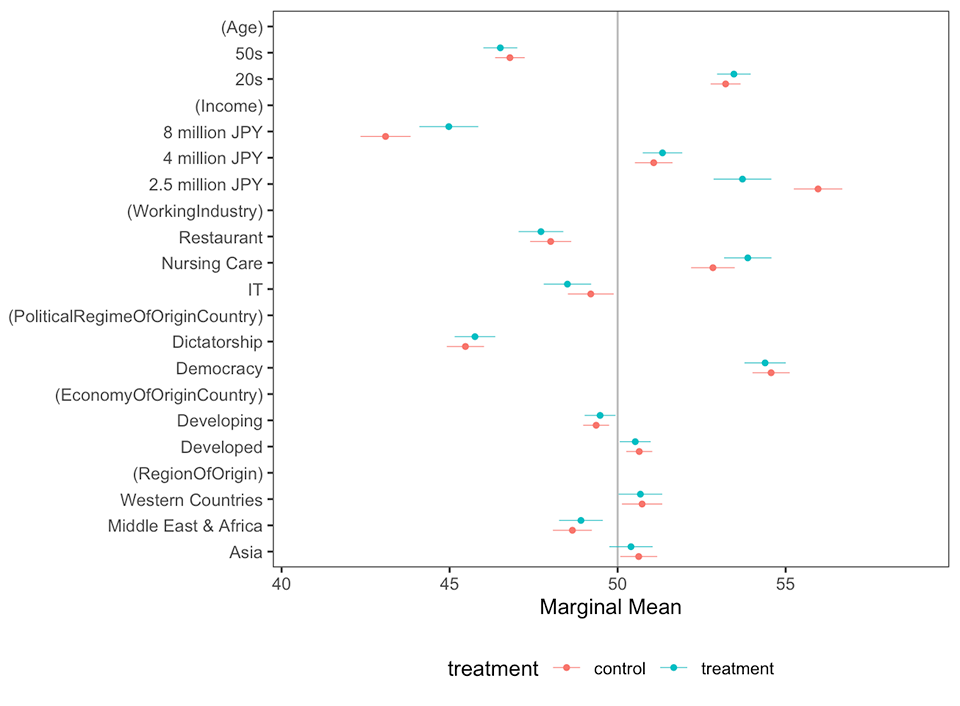
Image title: How information treatment shifts perceptions towards immigrants between treatment and control groups
Image caption: The results show that informing people about immigrants' participation in the healthcare system increases support for high-income immigrants.
Image credit: Associate Professor Tomoko Matsumoto from Tokyo University of Science, Japan
Image source link: https://link.springer.com/article/10.1007/s11127-026-01411-8
License type: CC BY-NC-ND 4.0
Usage restrictions: Credit must be given to the creator. Only noncommercial uses of the work are permitted. No derivatives or adaptations of the work are permitted.
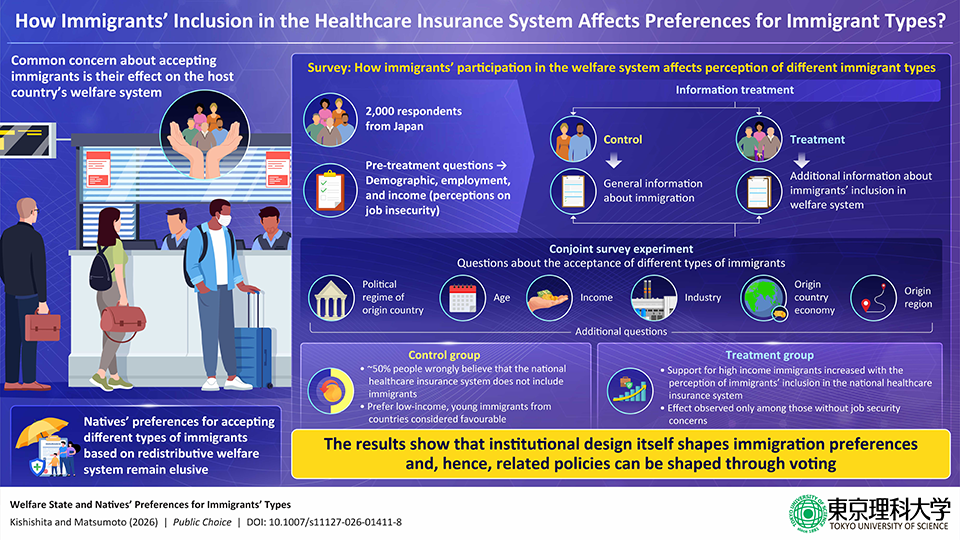
Image title: Perception of native people on the inclusion of immigrants in the welfare system
Image caption: Study on the inclusion of immigrants' healthcare insurance systems reveals higher preferences for high-income immigrants.
Image credit: Associate Professor Tomoko Matsumoto from Tokyo University of Science, Japan
License type: Original content
Usage restrictions: Credit must be given to the creator.
Reference
| Title of original paper | : | Welfare State and Natives' Preferences for Immigrants' Types |
| Journal | : | Public Choice |
| DOI | : | 10.1007/s11127-026-01411-8 |
About The Tokyo University of Science
Tokyo University of Science (TUS) is a well-known and respected university, and the largest science-specialized private research university in Japan, with four campuses in central Tokyo and its suburbs and in Hokkaido. Established in 1881, the university has continually contributed to Japan's development in science through inculcating the love for science in researchers, technicians, and educators.
With a mission of "Creating science and technology for the harmonious development of nature, human beings, and society," TUS has undertaken a wide range of research from basic to applied science. TUS has embraced a multidisciplinary approach to research and undertaken intensive study in some of today's most vital fields. TUS is a meritocracy where the best in science is recognized and nurtured. It is the only private university in Japan that has produced a Nobel Prize winner and the only private university in Asia to produce Nobel Prize winners within the natural sciences field.
■
Tokyo University of Science(About TUS)
About Associate Professor Tomoko Matsumoto
from Tokyo University of Science
Dr. Tomoko Matsumoto is an Associate Professor at Tokyo University of Science. She received her Ph.D. in Politics from the University of Tokyo in 2016. Her research focuses on quantitative political science, including public opinion, elections, redistribution, and elite mobility. She has published more than 10 papers and delivered over 70 presentations. She previously served as a Designated Lecturer at Nagoya University and as a Visiting Research Professor at New York University. In 2024, she received the Tokyo University of Science Outstanding Researcher Encouragement Award.
Funding information
This study was supported by JSPS KAKENHI (grant numbers: 22K13339, 22K13368, 26K16320, and 26K00300).