2026.06.08 Monday
Toward Standardized Microplastics Monitoring in Rivers
Researchers show that mathematical formulas can accurately estimate microplastic mass and size concentrations from partial data
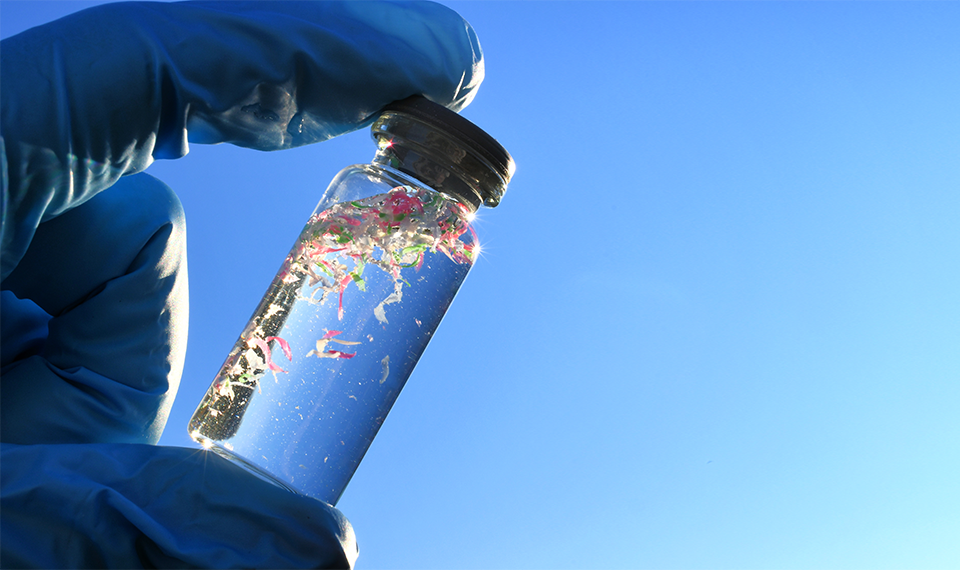
Microplastics (MPs), defined as plastic fragments smaller than 5 mm, have become so pervasive that they are detectable in nearly every environment studied—from remote ocean trenches to urban air, tap water, and human blood. MPs are hardly uniform; they span an enormous size range. Larger fragments are visible to the naked eye, while the smallest ones have a diameter of a few micrometers. These variations in size are important, as smaller particles are far more numerous, behave differently in water than larger particles, and may pose greater risks to aquatic organisms and human health.
Despite the threat that MPs represent, researchers have not established common standard methods for measuring and comparing MP pollution. Studies on river contamination have investigated different particle size ranges using methods that are often incompatible, offering no reliable way to combine the available data. Moreover, scientists have largely focused on counting particle numbers rather than measuring their mass, even though mass concentration is often a more meaningful indicator of the severity of plastic pollution.
To address these gaps, a research team led by Part-time Assistant Professor Mamoru Tanaka from the Faculty of Science and Technology, Tokyo University of Science, Japan, set out to characterize MP number and mass distributions in river water across a wide size range and determine whether a single mathematical model could unify the data. Their study, co-authored by second-year Master's student Mr. Kota Egoshi, employed three different sampling methods simultaneously to collect MPs ranging from 0.03 to 5 mm in size. The findings of the study were made available online on April 02, 2026, and was published in Volume 398 of the journal Environmental Pollution on June 01, 2026.
Dr. Tanaka shares as the motivation behind the study, "I learned that MPs does not disappear once released into the environment, but dissolves into nature while repeatedly being broken down. I decided to undertake this research because I wanted to unravel the invisible changes lurking in our immediate environment."
The team sampled water from Tsurumi River in Japan, which flows through densely populated areas in Tokyo and Kanagawa Prefectures. Treated wastewater accounts for roughly three-quarters of this river's flow, making it a direct channel for whatever MPs pass through the region's water treatment plants. The researchers collected water across seven field surveys at four sites along the river, using two plankton nets with different mesh sizes for larger MPs and stainless-steel buckets for smaller ones.
This sampling approach enabled the team to build a continuous size spectrum covering the full range of particle sizes in a single, coherent dataset. They then tested whether a power-law model could describe how both particle number and mass concentrations change across the size spectrum.
Interestingly, both particle number and mass concentrations followed consistent patterns across all samples. The number of particles increased sharply as MP size decreased, whereas mass showed a more stable distribution across MP sizes. Most importantly, the results demonstrate that these size spectra can be used to reliably estimate total MP mass. "Concentration estimation based on size-spectrum extrapolation showed that MP concentrations can be estimated with generally high accuracy, even when only limited size ranges of small MPs and large MPs are available," says Dr. Tanaka. "This high accuracy is largely attributable to the excellent fit of the power-law to the size spectrum at all the sampling locations."
In practical terms, the results suggest that researchers may no longer need to capture every size fraction to obtain reliable estimates of overall plastic contamination in rivers, which has clear implications for improving environmental monitoring. By allowing partial datasets to be extrapolated, it could enable more efficient surveys across larger geographic areas and over longer time periods. "By surveying only a portion of the MP size range, it will be possible to estimate MP concentrations of all sizes with high accuracy, which could reduce the manpower and time required for MP surveys. In this way, our research will contribute to the standardization of MP data and a quantitative understanding of MP contamination in the future," remarks Dr. Tanaka.
The new method can estimate the abundance of small microplastics <200 µm, which are typically overlooked during typical microplastic field survey. Small microplastics <200 µm can be typically found in organism's tissues. Revealing the dynamics of such microplastics can help in evaluating the impact of such plastics on the human body.
In the near future, a standardized framework for describing MP size distributions could help scientists track pollution sources and trends more consistently across regions. This would also support regulators in developing clearer benchmarks for water quality, addressing growing concerns over MPs in rivers that supply drinking water. Even though the study focused on a single river system, it highlights a pathway toward more comparable and scalable MPs research, marking an essential step for understanding and managing plastic pollution in freshwater environments.
Reference
| Title of original paper | : | Power-law size spectra of microplastic number and mass concentration in river water |
| Journal | : | Environmental Pollution |
| DOI | : | 10.1016/j.envpol.2026.128058 |
About The Tokyo University of Science
Tokyo University of Science (TUS) is a well-known and respected university, and the largest science-specialized private research university in Japan, with four campuses in central Tokyo and its suburbs and in Hokkaido. Established in 1881, the university has continually contributed to Japan's development in science through inculcating the love for science in researchers, technicians, and educators.
With a mission of "Creating science and technology for the harmonious development of nature, human beings, and society," TUS has undertaken a wide range of research from basic to applied science. TUS has embraced a multidisciplinary approach to research and undertaken intensive study in some of today's most vital fields. TUS is a meritocracy where the best in science is recognized and nurtured. It is the only private university in Japan that has produced a Nobel Prize winner and the only private university in Asia to produce Nobel Prize winners within the natural sciences field.
■
Tokyo University of Science(About TUS)
About Professor Yasuo Nihei from
from Tokyo University of Science
Assistant Professor Mamoru Tanaka
from Tokyo University of Science
Dr. Mamoru Tanaka obtained a Ph.D. in Marine Science from the Tokyo University of Marine Science and Technology in 2019. He currently serves as an Assistant Professor at the Tokyo University of Science, focusing on observational physical oceanography, microplastics, hydraulic engineering, and turbulent microstructure. He has 30 referee papers published under his name.
Funding information
This work was funded by the Environment Research and Technology Development Fund (grant number JPMEERF21S11900) of the Environmental Restoration, Conservation Agency of Japan.