2026.05.26 Tuesday
Discovery of Furtivovirus Advances Understanding of Giant Virus Evolution
Researchers report the discovery of furtivovirus, a giant amoeba-infecting virus, and clarify evolutionary relationships among giant viruses
In evolutionary biology, all life on Earth is theoretically part of a single phylogenetic tree, indicating common ancestry. This model suggests that every living organism can be traced back to a distant common ancestor. However, viruses, which are not made of cells but consist only of genetic material, are not part of this traditional cellular tree of life, raising important questions about their origin and evolution.
One hypothesis that attempts to explain this is the virus-derived cell nucleus theory, proposed by Professor Masaharu Takemura of Tokyo University of Science (TUS), Japan, in 2001. This theory suggests that the nucleus of eukaryotic cells may have originated from ancient viruses. After several months, Australian microbiologist Dr. Philip Bell proposed the viral eukaryogenesis theory, based on the same concept.
This idea gained attention following the discovery of the Acanthamoeba polyphaga mimivirus in 2003, the first known giant virus. These viruses belong to a group called Nucleocytoplasmic Large DNA Viruses, characterized by their large DNA genomes and complex structures. Some members of this group use the host cell nucleus during infection and form specialized regions, known as virus factories, where new virus particles are produced. As of 2025, this group has expanded into a diverse phylum known as Nucleocytoviricota, comprising multiple classes, orders, families, genera, and species.
Now, Prof. Takemura, along with doctoral student Jiwan Bae, reports the discovery of a new giant virus called furtivovirus, providing further insight into how these viruses interact with host cells. Based on genomic and evolutionary analyses, the researchers propose the creation of a new viral family, "Manesviridae," which would include furtivovirus and its close relatives. The study was made available online in the Journal of Virology on May 14, 2026.
"Although these viruses belong to the same group, they use the cell nucleus in different ways. If we can understand how giant viruses and host cells interact and evolve together, we may gain new insights into the significance of viruses as living organisms and how we can coexist with them," says Prof. Takemura.
The researchers isolated furtivovirus from freshwater samples collected in Kamakura, Japan, and cultured it using the amoeba Vermamoeba vermiformis as a host. They used electron microscopy to observe how the virus behaves inside infected cells and sequenced its genome. They then compared its genetic information with that of other known giant viruses, as well as environmental datasets, to identify similarities and differences.
Their analysis revealed that furtivovirus has a genome of about 560,000 base pairs and follows a unique replication strategy. It depends on the host cell nucleus, but instead of keeping it intact, it disrupts the nuclear membrane and produces new virus particles within the nucleoplasm, which is the fluid-filled interior of the nucleus where DNA is normally stored and processed. This behavior differs from that of medusaviruses, which replicate inside an intact nucleus, and ushikuvirus, which forms replication sites in the cytoplasm after breaking down the nucleus.
"By comparing three viruses that utilize the cell nucleus in different ways--the medusavirus, which replicates in the nucleus; the ushikuvirus, which breaks down the nuclear membrane and creates its own viral site in the cytoplasm; and the furtivovirus, discovered in this study, which breaks down the nuclear membrane but creates a viral site in the remaining nucleus--we can see the evolutionary pathway of interaction between the cell nucleus and these novel viruses," says Prof. Takemura.
These findings show that even closely related giant viruses can evolve very different strategies for interacting with their hosts. At the same time, their shared reliance on the nucleus suggests a common evolutionary origin, offering new insights into how viruses may have influenced the evolution of complex life.
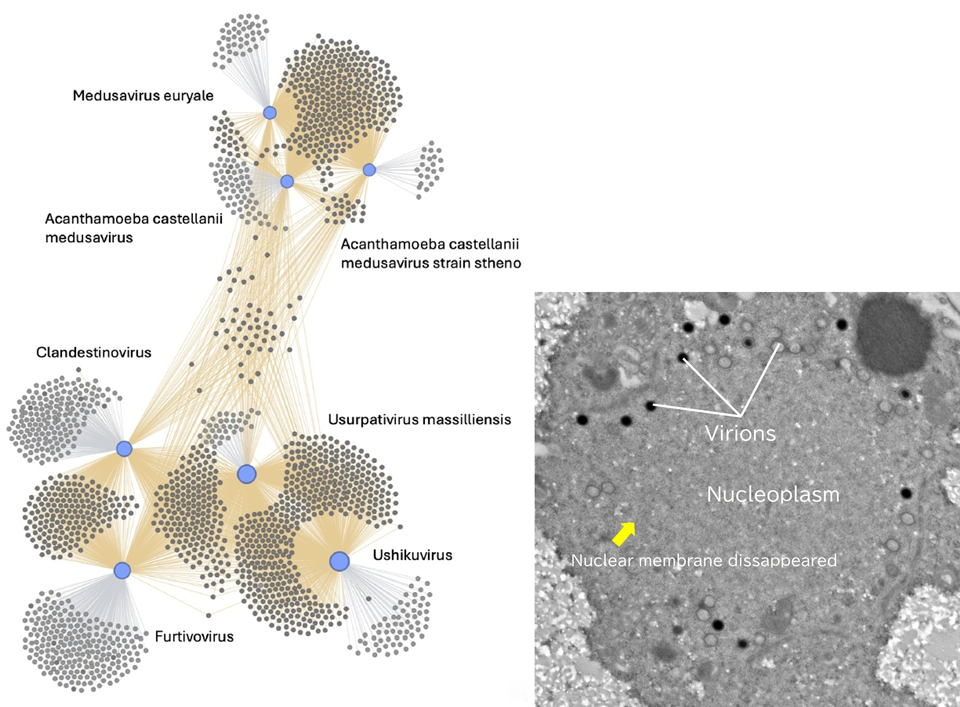
Image title: Gene-Sharing Network Reveals Evolutionary Links Among Giant Viruses
Image caption: Bipartite network showing shared proteins among the seven viruses. Blue nodes represent genomes, gray nodes represent proteins; gray lines indicate singletons, while wheat-colored lines indicate shared proteins, revealing evolutionary relationships. (Inset) shows furtivovirus replication inside a disrupted nucleus, producing viral particles within the nucleoplasm of the host amoeba.
Image credit: Mr Jiwan Bae and Professor Masaharu Takemura from Tokyo University of Science
License type: Original content
Usage restrictions: Cannot be used without permission.
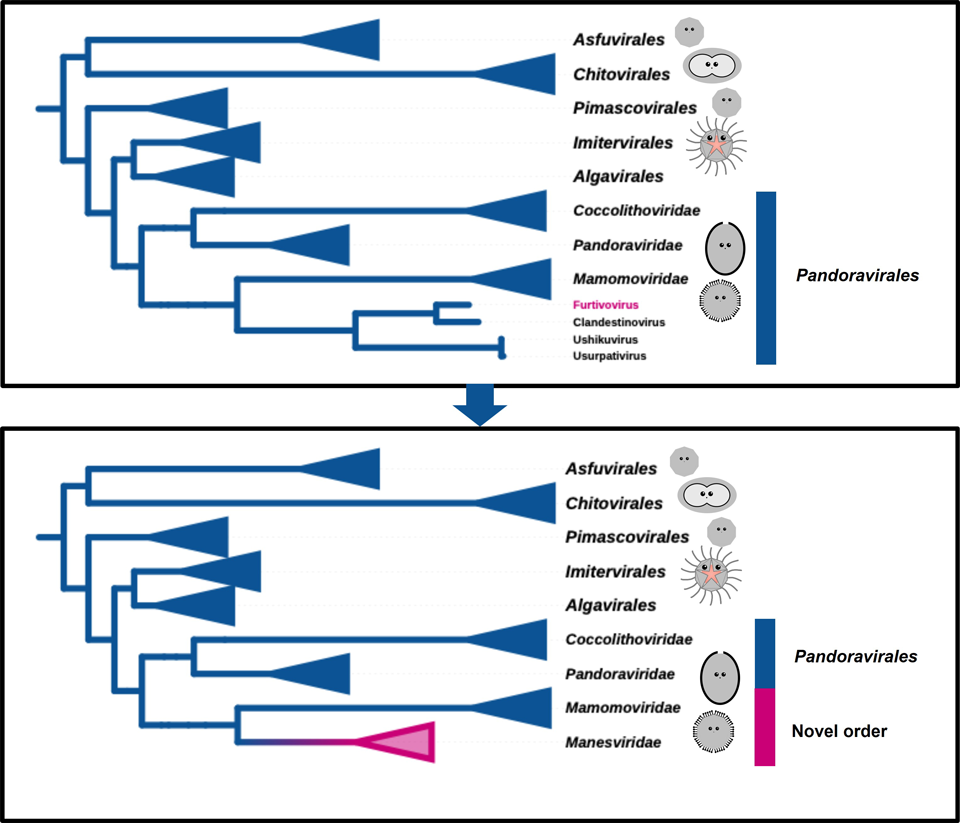
Image title: A New Branch on the Giant Virus Family Tree
Image caption: Researchers propose a new family, "Manesviridae," which includes the newly discovered furtivovirus and its close relatives. This family forms a sister group to Mamonoviridae, and together they define a proposed new order.
Image credit: Mr. Jiwan Bae and Professor Masaharu Takemura from Tokyo University of Science
License type: Original content
Usage restrictions: Cannot be used without permission.
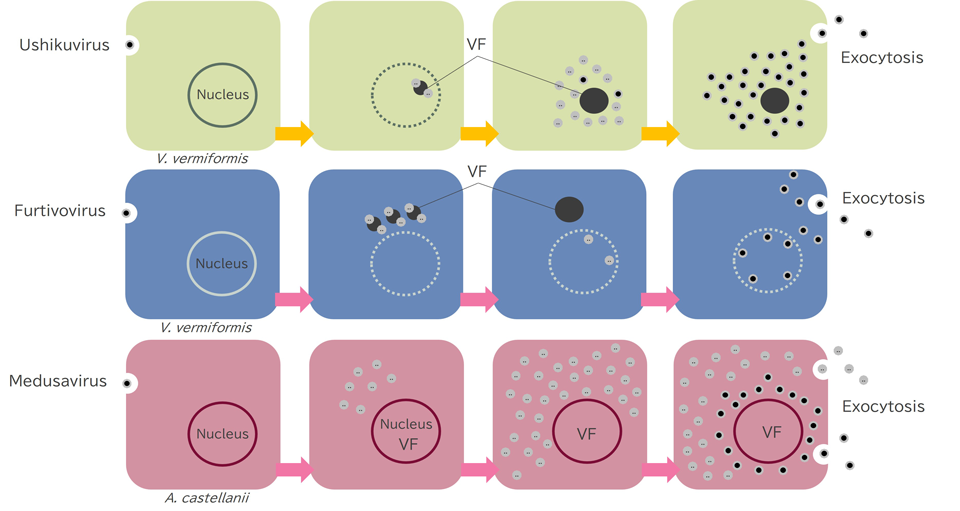
Image title: Replication Strategies of Giant Viruses Within Host Cells
Image caption: Medusavirus replicates inside the intact nucleus, Ushikuvirus disrupts the nucleus and replicates in the cytoplasm, while furtivovirus replicates within the nucleoplasm after partial nuclear disruption.
Image credit: Professor Masaharu Takemura from Tokyo University of Science
License type: Original content
Usage restrictions: Cannot be used without permission.
Reference
| Title of original paper | : | Refining a giant virus lineage: A novel order unifying Mamonoviridae and "Manesviridae," unveiled by the discovery of furtivovirus |
| Journal | : | Journal of Virology |
| DOI | : | 10.1128/jvi.02031-25 |
About The Tokyo University of Science
Tokyo University of Science (TUS) is a well-known and respected university, and the largest science-specialized private research university in Japan, with four campuses in central Tokyo and its suburbs and in Hokkaido. Established in 1881, the university has continually contributed to Japan's development in science through inculcating the love for science in researchers, technicians, and educators.
With a mission of "Creating science and technology for the harmonious development of nature, human beings, and society," TUS has undertaken a wide range of research from basic to applied science. TUS has embraced a multidisciplinary approach to research and undertaken intensive study in some of today's most vital fields. TUS is a meritocracy where the best in science is recognized and nurtured. It is the only private university in Japan that has produced a Nobel Prize winner and the only private university in Asia to produce Nobel Prize winners within the natural sciences field.
■
Tokyo University of Science(About TUS)
About Professor Masaharu Takemura
from Tokyo University of Science
Dr. Masaharu Takemura is a Professor in the Department of Mathematics and Science Education, Graduate School of Science at the Tokyo University of Science, Japan. His research interests include giant virus biology, viral eukaryogenesis, and virus education. Over his career, he has published more than 120 papers, amassing over 2,500 citations for his work. His research goal is to elucidate the evolution of giant viruses and eukaryotes and develop teaching materials for virus education.
Funding information
This research was supported by JSPS/KAKENHI (grant number: 20H03078) and Joint Research of the Exploratory Research Center on Life and Living Systems (ExCELLS) (program number: 22EXC601-4).