2026.04.24 Friday
Twisted Nanoparticles Sorted by Light
Light near the surface of ultra-thin optical fibers allows sorting of chiral nanoparticles based on their handedness

Many important objects in the world can be divided into two categories based on their chirality or handedness, including molecules important for life such as amino acids. Such chiral objects (formally defined as objects which are not identical to their mirror images) are often characterized by a structure which twists in a given direction. An everyday example of a chiral object is a screw. A right-handed screw moves into a material when rotated clockwise, but its mirror image (i.e., a left-handed screw) moves out.
Just as right- and left-handed screws behave differently when turned, chiral particles behave differently when exposed to light with a circular polarization. This fact allows them to be sorted in principle, which is expected to be important for applications such as drug development, where the handedness of a chiral molecule determines how it interacts with biological systems.
Now, in a study published in Volume 17, Article number 3463 of the journal Nature Communications on April 16, 2026, researchers from Tokyo University of Science (TUS), Japan; Institute for Molecular Science (IMS), Japan; and Seoul National University (SNU), Republic of Korea, have demonstrated a method for manipulating metallic chiral nanoparticles using light. Their study addresses a key challenge in the field: controlling nanoscale chiral objects.
The study's first author Dr. Georgiy Tkachenko and second author Akiyoshi Suda performed the original experiments at TUS using particles fabricated at IMS by Dr. Hyo-Yong Ahn. Other contributions were made by former and current students at TUS, Yamato Iida, Ichiro Kurihara and Koki Saito, along with In Han Ha at SNU. The research user optical fiber techniques developed at Professor Mark Sadgrove's group at TUS along with chiral nanoparticles developed by Professor Ki Tae Nam's group at SNU and expertise in chiral nanoparticle optical properties developed by Professor Hiromi Okamoto's group at IMS.
Light can manipulate objects by transferring momentum producing a tiny pushing force. With circularly polarized light, this force can depend on chirality, pushing left- and right-handed particles differently. However, as particles become smaller, their interaction with light weakens, while random motion becomes relatively stronger, often overwhelming these forces.
"While circularly polarized light has been used to separate microparticles (whose size is about the width of a human hair), applying the same approach to nanoparticles, which are 1,000 times smaller, has not been successful. Given that the eventual aim is to reach the size of a molecule (about 1-10 nm), this limitation is a serious problem," says Prof. Sadgrove.
To overcome this limitation, the researchers used tightly confined light to enhance its interaction with the particles. They achieved this using an ultra-thin optical fiber, where light is concentrated near the fiber surface in a region known as an evanescent field. This creates a more localized force compared to ordinary light beams. By using circularly polarized light (where the electric field rotates as the light travels), they created a situation in which left- and right-handed particles experience different forces.
The team examined this effect using tiny metallic nanocubes with twisted faces, giving them a defined chirality. When these particles were placed near the optical fiber, they moved along its length under the influence of the evanescent field. Importantly, the direction and speed of this motion depended on both the handedness of the particles and the polarization of the light.
By switching the circular polarization of the light between clockwise and anticlockwise, the researchers could reverse how left- and right-handed particles responded, changing the direction in which they moved along the fiber. This enabled chirality-selective transport and effective optical separation of the nanoparticles.
"When Dr. Georgiy Tkachenko showed me the initial results, I was stunned," says Prof. Sadgrove. "I never imagined that the effect would be large enough to show up in the raw data. I think this really shows the advantages of using such thin optical fibers for optical manipulation."
By demonstrating that chiral nanoparticles can be selectively transported using light, this study provides a simpler and more effective way to control chirality at very small scales. Looking ahead, the researchers suggest that if this approach can be extended to particles that are 10 to 100 times smaller, it may become possible to manipulate individual molecules. This could open up new ways to study chirality in biological systems and lead to improved techniques for separating and designing drugs based on their molecular handedness.
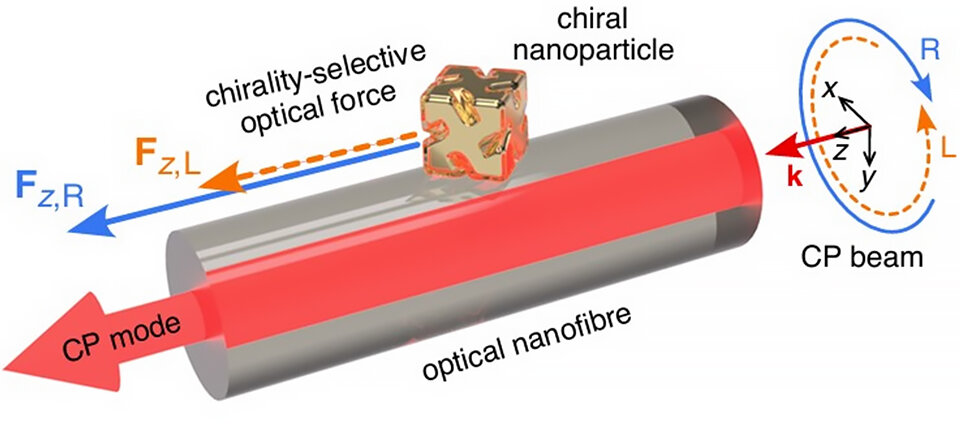
Image title: Selective optical transport of chiral nanoparticles
Image caption: The image illustrates nanoparticles moving along an optical nanofiber under the influence of circularly polarized light. Chiral nanocubes near the fiber experience a force, which depends on both their handedness and the polarization of the light.
Image credit: Dr. Mark Sadgrove from Tokyo University of Science, Japan
Image source link: https://www.nature.com/articles/s41467-026-71585-8
License type: CC BY-NC-ND 4.0
Usage restrictions: Credit must be given to the creator. Only noncommercial uses of the work are permitted. No derivatives or adaptations of the work are permitted.
Reference
| Title of original paper | : | Chirality-selective optical transport of nanoparticles in the evanescent field of a nanofibre |
| Journal | : | Nature Communications |
| DOI | : | 10.1038/s41467-026-71585-8  |
About The Tokyo University of Science
Tokyo University of Science (TUS) is a well-known and respected university, and the largest science-specialized private research university in Japan, with four campuses in central Tokyo and its suburbs and in Hokkaido. Established in 1881, the university has continually contributed to Japan's development in science through inculcating the love for science in researchers, technicians, and educators.
With a mission of "Creating science and technology for the harmonious development of nature, human beings, and society," TUS has undertaken a wide range of research from basic to applied science. TUS has embraced a multidisciplinary approach to research and undertaken intensive study in some of today's most vital fields. TUS is a meritocracy where the best in science is recognized and nurtured. It is the only private university in Japan that has produced a Nobel Prize winner and the only private university in Asia to produce Nobel Prize winners within the natural sciences field.
■
Tokyo University of Science(About TUS)
About Professor Mark Sadgrove from Tokyo University of Science
Mark Paul Sadgrove is a Professor in the Department of Physics at the Tokyo University of Science. He holds a Ph.D. in physics from the University of Auckland and has over 20 years of research experience in quantum and transport physics. His work focuses on nano-optics, nano-transport, and light-matter interactions, particularly using optical nanofibers to manipulate atoms, nanoparticles, and photons. Prof. Sadgrove has authored more than 45 peer-reviewed publications and contributed to numerous academic presentations. His notable contributions include advancing research in near-field optics and serving as a co-organizer and committee member for international photonics conferences.
About Assistant Professor Xuan Yining from Tokyo University of Science
Funding information
This work was supported by KAKENHI Grant-in-Aid for Transformative Research Areas (Grant No. JP22H05135) and for Scientific Research (A) (Grant No. JP21H04641).