2026.04.13 Monday
Making Light Spin with a Gold Nanorod
By striking a gold nanorod off-center with an electron beam, researchers found a simple way to make light spin
Light, as we usually conceive of it, is defined by the astonishing velocity at which it moves from one point to another. For example, in just one second light can travel most of the distance between the Earth and the Moon. This property is what makes light useful for communication, which we expect to happen at lightning speed in the modern age.
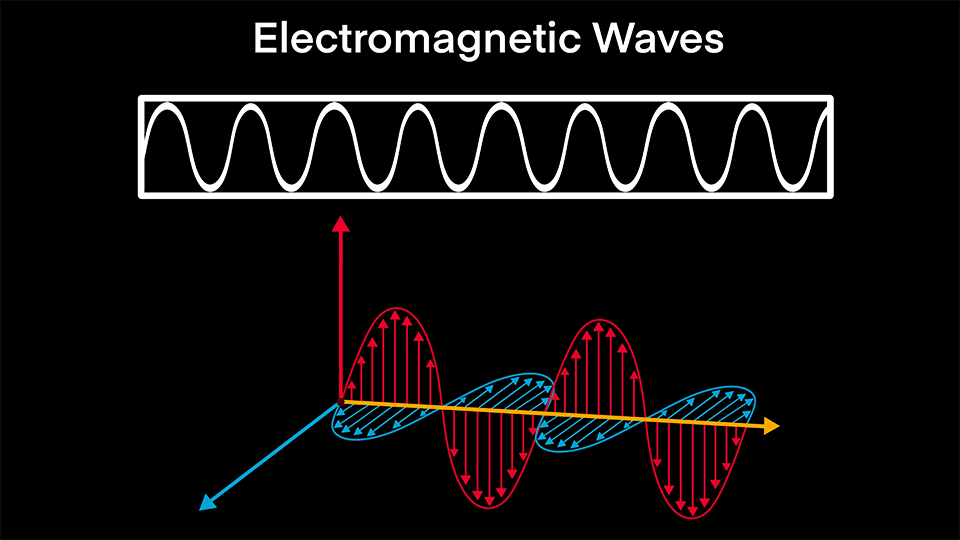
It may, therefore, seem strange that many modern breakthroughs in the scientific study of light consider confining it to regions much smaller than the thickness of a human hair. In such small volumes―often measured in the tens of nanometers―light can be shaped by the type and geometry of the material it travels in. An important property of light in this aspect is its polarization, which determines how the electric field oscillates as the light travels. In linearly polarized light, the electric field oscillates back and forth along a fixed direction, like a rope when shaken up and down. In circular polarization, the electric field rotates as the light travels, leading to a helical pattern. The circular polarization of light is also referred to as its "spin," and the spin property can be used to encode and transmit information, as well as to control how light propagates through nanoscale devices.
However, producing light with spin at the nanoscale presents a challenge, as the shape of the material often determines polarization. For example, much like a radio antenna, an elongated nanostructure tends to produce light polarized along its elongated axis, rather than the desired rotating light.
Against this backdrop, researchers from the Tokyo University of Science, in collaboration with Institute for Molecular Science, Japan, have found a way around this limitation. The team, led by Professor Mark Sadgrove from the Department of Physics, and including co-first authors Dr. Yining Xuan and second-year Master's student Daito Miyazaki, showed that striking a gold nanorod about 150 nanometers long with an off-center electron beam causes the surrounding light to take on a rotating character. Their paper was made available online on February 9, 2026, and was published in Volume 26, Issue 6 of the journal Nano Letters on February 18, 2026.
Prof. Sadgrove gives intuition for this effect with a simple analogy: "If you have ever flicked one end of a pen lying on a table, you will be familiar with the fact that as well as moving forward, the pen also tends to rotate." Although the principle of light generation is very different from this everyday example, the concept of introducing an imbalance to produce a spin is applicable. In particular, the farther the beam strikes from the center of the nanorod, the stronger the spin of the light. Importantly, this off-center excitation of the nanorod produces circular polarization, even though the elongated shape of the rod typically produces only standard linear polarization.
Demonstrating that the light near the rod was circularly polarized required a creative approach. In typical experiments of this kind, only the brightness of the light is recorded, with no way to confirm whether it has spin. To solve this, the researchers placed the gold nanorod on an ultra-thin optical fiber that has a special property: the direction that light travels through the fiber depends on whether the light near the rod is spinning clockwise or counterclockwise. By measuring which end of the fiber the light emerged from, they were able to confirm the rotation. "Although the effect seems simple, it was only our familiarity with the properties of optical fibers, which allowed us to actually measure it," says Prof. Sadgrove.
The experiments closely matched what the simulations predicted. As the electron beam shifted from one side of the nanorod to the other, the direction in which light traveled through the fiber flipped, revealing a switch in the rotation of the light.
By showing that an off-center excitation can generate rotating light even in a simple nanostructure, the study offers a more straightforward way to control the spin of light, even for single particles of light (photons). This could be especially useful in integrated optical circuits, where compact and efficient control of light is essential. Looking ahead, this approach may enable new ways to encode, route, and process information using light, supporting advances in quantum communication and next-generation photonic technologies.
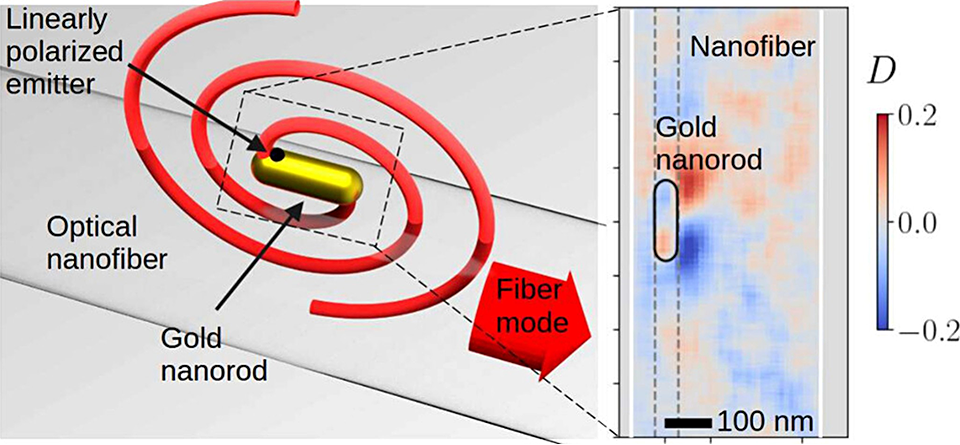
Image title: Off-center emitter (here created by an electron beam) on a nanorod creates light with a spin
Image caption: (Left) Illustration of the spin of the light field around a gold nanorod coupled to an ultra-thin optical fiber. (Inset) Experimental measurements showing the magnitude of the optical spin (D) generated at the nanoscale.
Image credit: Professor Mark Sadgrove from Tokyo University of Science, Japan
Image link: https://pubs.acs.org/doi/10.1021/acs.nanolett.5c05644
License type: CC-BY 4.0
Usage restrictions: Credit must be given to the creator.
Reference
| Title of original paper | : | Creation and Detection of Optical Spin in a Coupled Emitter−Plasmon System |
| Journal | : | Nano Letters |
| DOI | : | 10.1021/acs.nanolett.5c05644  |
About The Tokyo University of Science
Tokyo University of Science (TUS) is a well-known and respected university, and the largest science-specialized private research university in Japan, with four campuses in central Tokyo and its suburbs and in Hokkaido. Established in 1881, the university has continually contributed to Japan's development in science through inculcating the love for science in researchers, technicians, and educators.
With a mission of "Creating science and technology for the harmonious development of nature, human beings, and society," TUS has undertaken a wide range of research from basic to applied science. TUS has embraced a multidisciplinary approach to research and undertaken intensive study in some of today's most vital fields. TUS is a meritocracy where the best in science is recognized and nurtured. It is the only private university in Japan that has produced a Nobel Prize winner and the only private university in Asia to produce Nobel Prize winners within the natural sciences field.
■
Tokyo University of Science(About TUS)
About Professor Mark Sadgrove from Tokyo University of Science
Mark Paul Sadgrove is a Professor in the Department of Physics at the Tokyo University of Science. He holds a Ph.D. in physics from the University of Auckland and has over 20 years of research experience in quantum and transport physics. His work focuses on nano-optics, nano-transport, and light-matter interactions, particularly using optical nanofibers to manipulate atoms, nanoparticles, and photons. Prof. Sadgrove has authored more than 45 peer-reviewed publications and contributed to numerous academic presentations. His notable contributions include advancing research in near-field optics and serving as a co-organizer and committee member for international photonics conferences.
Funding information
This work was supported by KAKENHI Grant-in-Aid for Transformative Research Areas (Grant Number: JP22H05135).