2026.02.17 Tuesday
Unveiling Powerful Synergies Between Plant Compounds That Dramatically Reduce Inflammation
Researchers discover that familiar food ingredients can work together inside immune cells to drastically boost each other's anti-inflammatory effects
Chronic inflammation often manifests as a silent process, causing no immediate pain or major symptoms. However, if left unchecked, it can eventually turn into a silent killer by contributing to serious conditions including type 2 diabetes, cardiovascular diseases, obesity, arthritis, and even cancers. At the cellular level, inflammation is driven by immune cells that release chemical signals to fight perceived infections or injury, and diet is known to influence this process. Many everyday foods and seasonings—such as herbs, spices, and aromatic plants—contain natural compounds called phytochemicals that can regulate inflammatory pathways. For centuries, these ingredients have been used together in traditional cuisine and herbal practices, long before their biological effects were understood.
Despite this long history, modern science has struggled to understand the anti-inflammatory mechanisms driven by plant-based ingredients. Many individual plant compounds show anti-inflammatory effects in laboratory experiments, but only at concentrations much higher than those possible to reach through a normal diet. As a result, there has been skepticism about whether so-called 'anti-inflammatory foods' can meaningfully affect immune responses in the body. Even more unclear is how different compounds might work together inside cells in a synergistic manner, with specific combinations producing stronger effects than single ingredients alone. Such synergies have rarely been measured experimentally, nor explained at the molecular level.
To address these questions, a research team led by Professor Gen-ichiro Arimura from the Department of Biological Science and Technology, Tokyo University of Science, Japan, investigated how combinations of familiar plant-derived compounds produce anti-inflammatory effect in immune cells. Their study, published in Volume 18, Issue 3 of the journal Nutrients on January 23, 2026, examined whether pairing compounds found in mint, eucalyptus, and chili peppers could suppress inflammatory signals more effectively than using each compound independently.
The researchers focused on macrophages, a type of immune cell that plays a central role in inflammation by producing small signaling proteins called cytokines, which promote inflammation. In their experiments, murine macrophages were stimulated with lipopolysaccharide, a bacterial component commonly used to trigger inflammation in cellular studies. The team then treated these cells with menthol (from mint), 1,8-cineole (from eucalyptus), capsaicin (from chili peppers), and β-eudesmol (from hops and gingers), both individually and in carefully controlled combinations.
Using gene expression analysis, protein level measurements, and calcium imaging analysis, the researchers examined how these compounds affected key inflammatory biomarkers. They also tested whether the plant compounds acted through transient receptor potential (TRP) channels; these are proteins in the cell membrane that sense chemical and physical stimuli and help regulate calcium signaling, which is important for immune cell activation.
When used alone, capsaicin stood out as the most potent anti-inflammatory compound. However, the most striking synergistic results appeared for compound combinations. "When capsaicin and menthol or 1,8-cineole were used together, their anti-inflammatory effect increased several hundred-fold compared to when each compound was used alone," highlights Prof. Arimura.
Further experiments aided in elucidating the mechanism behind the synergistic function. Menthol and 1,8-cineole acted through TRP channels and calcium signaling, whereas capsaicin has been suggested to suppress inflammation through a different pathway independent of TRP. "We demonstrated that this synergistic effect is not a coincidence, but is based on a novel mode of action resulting from the simultaneous activation of different intracellular signaling pathways," says Prof. Arimura. "This provides clear molecular-level evidence for the empirically known effects of combining food ingredients."
These findings help explain how mixtures of plant compounds could exert notable biological effects even at low doses achievable through diet. Moreover, they suggest new ways to design functional foods, supplements, seasonings, or fragrances that deliver strong effects using small amounts of their active ingredients.
Broadly speaking, the study supports the idea that the health benefits of plant-rich diets may arise not from single 'super compounds,' but from cooperative or synergistic interactions among many plant components.
While further studies in animal models and humans are needed to cement these conclusions, this work provides a clearer scientific basis for understanding how everyday foods and natural anti-inflammatory compounds may help regulate chronic inflammation, ultimately supporting long-term health.
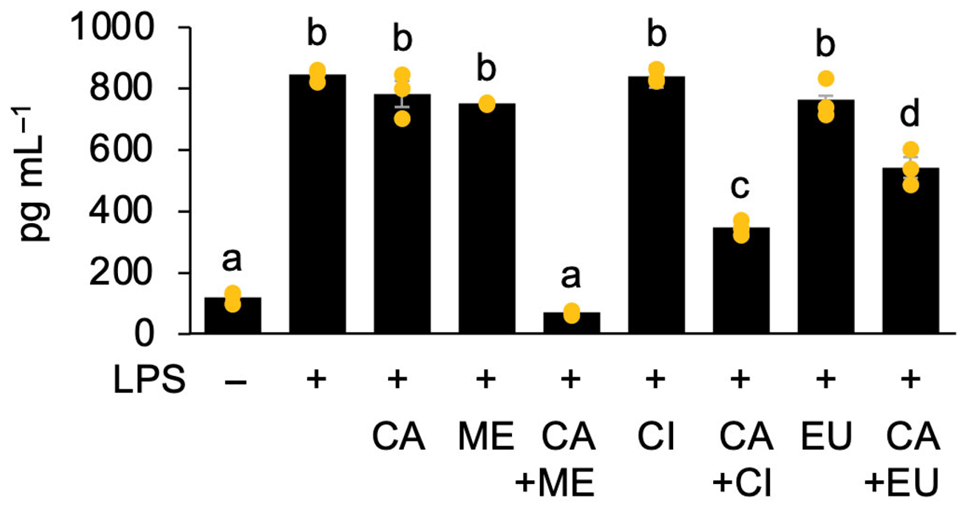
Image title: Anti-inflammatory effects of capsaicin in combination with other natural compounds
Image caption: This plot shows the measured TNF-α protein concentration released by macrophages as an indicator of inflammation. Combining capsaicin (CA) with either menthol (ME) or 1,8-cineole (CI) drastically reduced inflammation levels induced by bacterial lipopolysaccharide protein.
Image credit: Professor Gen-ichiro Arimura from Tokyo University of Science, Japan
Image link: https://doi.org/10.3390/nu18030376
License type: CC BY 4.0
Usage restrictions: Credit must be given to the creator.
Reference
| Title of original paper | : | Functional Phytochemicals Cooperatively Suppress Inflammation in RAW264.7 Cells |
| Journal | : | Nutrients |
| DOI | : | 10.3390/nu18030376  |
About The Tokyo University of Science
Tokyo University of Science (TUS) is a well-known and respected university, and the largest science-specialized private research university in Japan, with four campuses in central Tokyo and its suburbs and in Hokkaido. Established in 1881, the university has continually contributed to Japan's development in science through inculcating the love for science in researchers, technicians, and educators.
With a mission of "Creating science and technology for the harmonious development of nature, human beings, and society," TUS has undertaken a wide range of research from basic to applied science. TUS has embraced a multidisciplinary approach to research and undertaken intensive study in some of today's most vital fields. TUS is a meritocracy where the best in science is recognized and nurtured. It is the only private university in Japan that has produced a Nobel Prize winner and the only private university in Asia to produce Nobel Prize winners within the natural sciences field.
■
Tokyo University of Science(About TUS)
About Professor Gen-ichiro Arimura
from Tokyo University of Science
Dr. Gen-ichiro Arimura is a Professor in the Department of Biological Science and Technology at Tokyo University of Science, Japan. Prof. Arimura earned his Ph.D. degree in 1998 from Hiroshima University Graduate School. His research interests include biological communications, plant biotechnology, and plant ecology. Since 1996, he has published 130 peer-reviewed papers that have been cited over 6,600 times. He holds four patents and received an award from the International Society of Chemical Ecology in 2023.
Funding information
This work was partially supported by Japan Society for the Promotion of Science (JSPS) KAKENHI (24K01723) and Tokyo University of Science Research Grants.