2026.01.30 Friday
Breakthrough Method to Tame Combustion Instability Using Complex Networks
Using network science, researchers propose a novel way to suppress dangerous oscillations that can occur in combustors
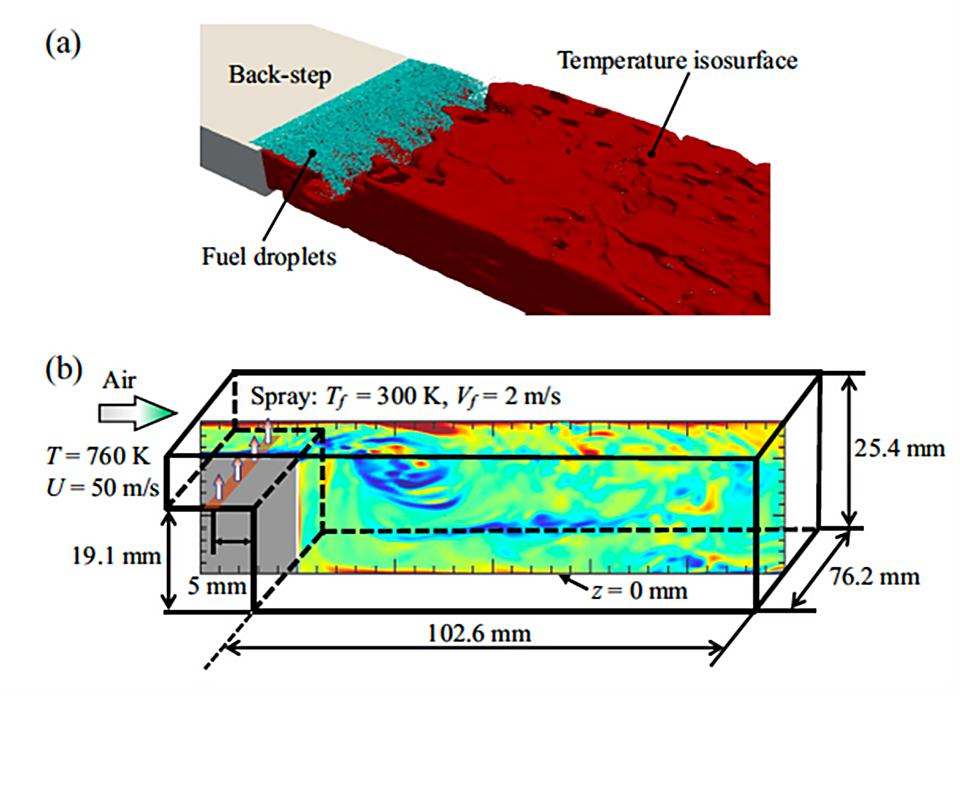
Engineers have long battled a problem that can cause loud, damaging oscillations inside gas turbines and aircraft engines: combustion instability. These unwanted pressure fluctuations create vibrations so intense that they can cause fatal structural damage to combustor walls, posing a serious threat in many applications. Combustion instability occurs when acoustic waves, heat release, and flow patterns interact in a strong feedback loop, amplifying each other until the entire system becomes unstable.
The complex interaction has made it difficult to predict when and where dangerous oscillations will emerge. This challenge has motivated researchers to seek new analytical frameworks that can capture the key driving regions of combustion instability.
Now, a research team led by Professors Hiroshi Gotoda from Tokyo University of Science and Ryoichi Kurose from Kyoto University, Japan, has developed an innovative approach using network science to understand and suppress combustion instability. Their paper, published in Volume 24, Issue 1 of the journal Physical Review Applied on July 1, 2025, applies complex network analysis to spray combustion instability in a backward-facing step combustor.
In the 'turbulence network,' each point in the flow field is represented as a node with connections representing the strength of vortex interactions. The study reveals that the network exhibits a scale-free topology, which is a pattern where a few highly connected hubs dominate the entire system's behavior.
The team discovered that these network hubs appear and disappear in sync with the formation and collapse of large-scale organized vortices. When such organized vortex structures form, a scale-free network topology emerges; when they collapse, the network topology disappears. Most importantly, the researchers identified specific regions that they referred to as 'connector communities'--areas where different parts of the network interact most strongly. By strategically placing small physical obstacles in these critical regions, they successfully suppressed combustion instability. The obstacles disrupt the vortex interactions that sustain the destructive feedback loop, significantly reducing both acoustic pressure fluctuations and the coupling between pressure and heat release oscillations.
This work reveals the dynamic appearance, disappearance, and reappearance of scale-free topologies during spray combustion instability. This discovery extends our understanding beyond earlier research on gaseous combustion systems. Notably, this approach provides engineers with a new tool for identifying where to intervene in combustion systems to prevent instability, potentially leading to more stable combustors across various industrial applications.
Overall, the network-based analysis used in this study represents a promising fusion of mathematical information science with combustion research, offering a new paradigm for understanding complex fluid dynamics. "Our work shows that turbulence networks not only characterize the structural organization of turbulent flows but also provide deeper insights into the temporal evolution of dominant flow structures," note Profs. Gotoda and Kurose. "These findings offer important insights into network-based strategies for suppressing combustion instability." This approach could be valuable for designing new combustors for gas turbines used for power generation and aircraft engines, contributing to multiple sustainable development goals in the form of cleaner energy and higher industrial and transportation efficiency.
Further work in this field will help address critical needs in new combustor design. "In our next study, we will conduct numerical simulations with different geometries and sizes of the obstacle to gain a deeper understanding of the suppression mechanism of spray combustion instability," comment Profs. Gotoda and Kurose, with eyes on the future.
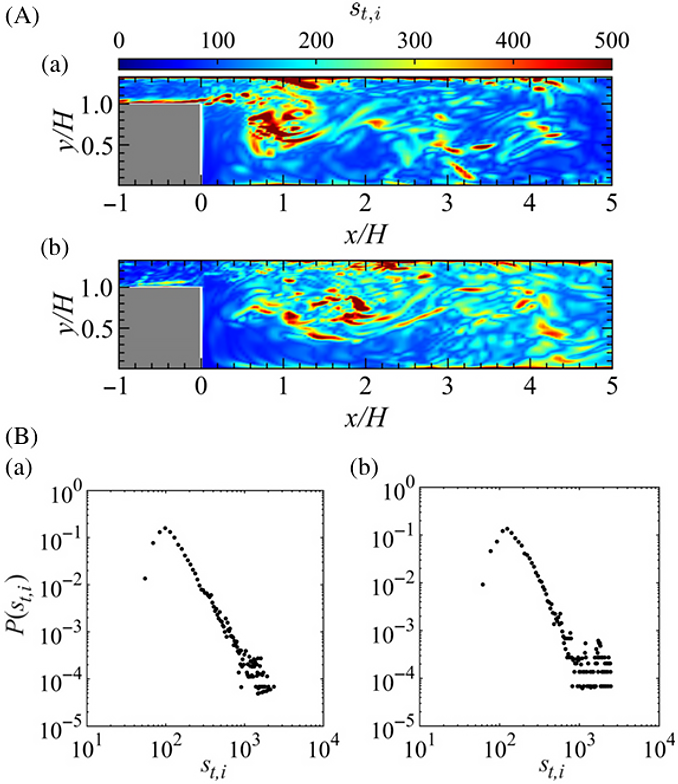
Image title: Spatial Distribution and Statistical Properties of Node Strength in a Network
Image caption: This figure illustrates the "scale-free" nature of the turbulence network during spray combustion instability. (A) The spatial distribution of node strength reveals highly connected hubs (red regions) that dominate the flow behavior at two different time intervals, (a) and (b). (B) The probability density function confirms that the network follows a power-law distribution, a hallmark of scale-free systems, where a few critical nodes (hubs) exert a disproportionate influence on the entire system's stability.
Source link: https://doi.org/10.1103/zhkg-c3kh
Image credit: ©2025 American Physical Society
License type: Licensed content
Usage restrictions: Cannot be used without permission.
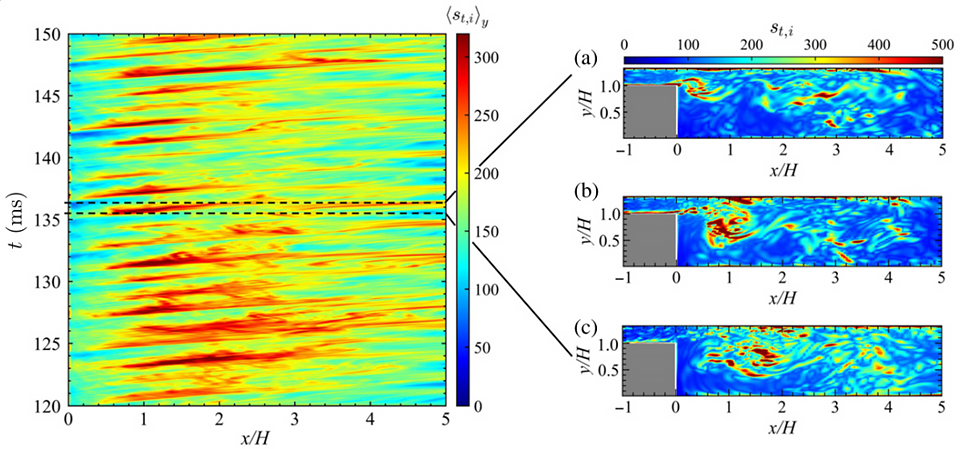
Image title: Spatiotemporal Dynamics of Node Strength
Image caption: This visualization tracks how the node strength in the turbulence network evolves over time. Panels (a), (b), and (c) provide "snapshots" of the node strength fields at 0.4-ms intervals. These snapshots demonstrate the periodic appearance and disappearance of the network hubs, which the researchers found to be synchronized with the formation and collapse of large-scale organized vortices.
Source link: https://doi.org/10.1103/zhkg-c3kh
Image credit: ©2025 American Physical Society
License type: Licensed content
Usage restrictions: Cannot be used without permission.
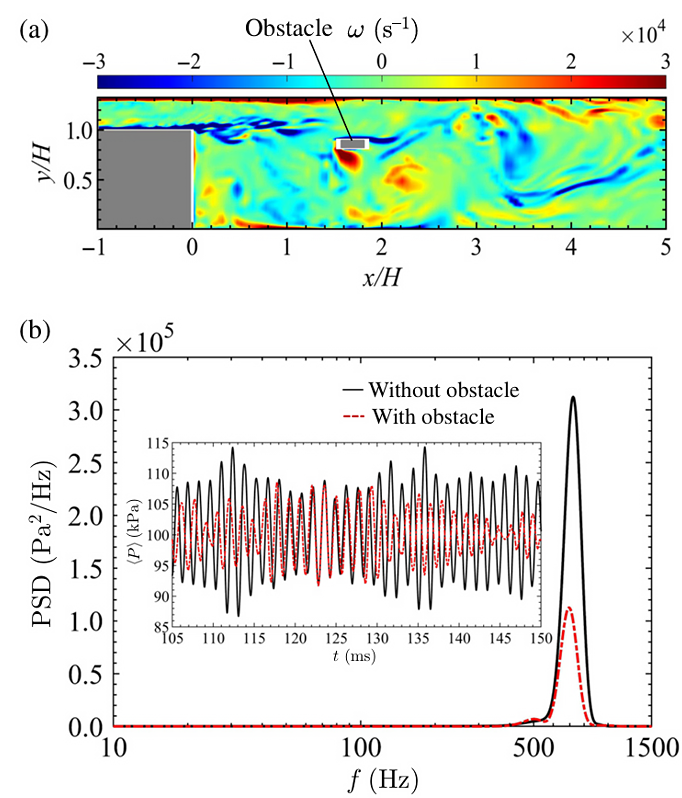
Image title: Suppression of Spray Combustion Instability
Image caption: The graph shows the power density distribution of acoustic pressure fluctuations with and without an obstacle: the red line represents the high-amplitude acoustic pressure fluctuations, while the black line shows the significant reduction in acoustic pressure fluctuations by setting an obstacle at the local region where the connector communities are mostly formed in the turbulent network.
Source link: https://doi.org/10.1103/zhkg-c3kh
Image credit: ©2025 American Physical Society
License type: Licensed content
Usage restrictions: Cannot be used without permission.
Reference
| Title of original paper | : | Network dynamics and suppression of spray combustion instability in a backward-facing step combustor |
| Journal | : | Physical Review Applied |
| DOI | : | 10.1103/zhkg-c3kh |
| Authors | : | Kenta Kato1, Hiroshi Gotoda1, Yusuke Nabae1, Maho Kawai2, and Ryoichi Kurose2 |
| Affiliations | : | 1Department of Mechanical Engineering, Tokyo University of Science, Japan 2Department of Mechanical Engineering and Science, Kyoto University, Japan |
Reference
| Title of original paper | : | Dynamic behavior and driving region of spray combustion instability in a backward-facing step combustor |
| Journal | : | Physical Review E |
| DOI | : | 10.1103/PhysRevE.110.024204 |
| Authors | : | Kenta Kato1, Hiroyuki Hashiba1, Jun Nagao2, Hiroshi Gotoda1, Yusuke Nabae1, and Ryoichi Kurose2 |
| Affiliations | : | 1Department of Mechanical Engineering, Tokyo University of Science, Japan 2Department of Mechanical Engineering and Science, Kyoto University, Japan |
About The Tokyo University of Science
Tokyo University of Science (TUS) is a well-known and respected university, and the largest science-specialized private research university in Japan, with four campuses in central Tokyo and its suburbs and in Hokkaido. Established in 1881, the university has continually contributed to Japan's development in science through inculcating the love for science in researchers, technicians, and educators.
With a mission of "Creating science and technology for the harmonious development of nature, human beings, and society," TUS has undertaken a wide range of research from basic to applied science. TUS has embraced a multidisciplinary approach to research and undertaken intensive study in some of today's most vital fields. TUS is a meritocracy where the best in science is recognized and nurtured. It is the only private university in Japan that has produced a Nobel Prize winner and the only private university in Asia to produce Nobel Prize winners within the natural sciences field.
■
Tokyo University of Science(About TUS)