2026.01.19 Monday
Observing Positronium Beam as a Quantum Matter Wave for the First Time
First experimental observation of matter-wave diffraction in a short-lived electron-positron atom
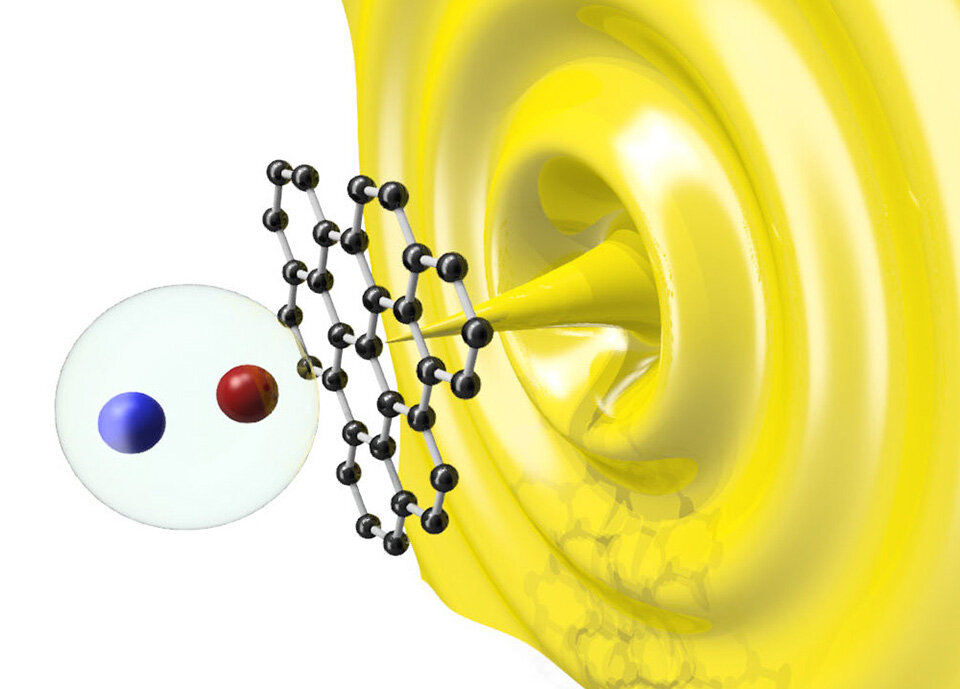
One of the discoveries that fundamentally distinguished the emerging field of quantum physics from classical physics was the observation that matter behaves differently at the smallest scales. A key finding was wave-particle duality, the revelation that particles can exhibit wave-like properties.
This duality was famously demonstrated in the double-slit experiment. When electrons were fired through two slits, they created an interference pattern of light and dark fringes on a detector. This pattern showed that each electron behaved like a wave, with its quantum wave-function passing through both slits and interfering with itself. The same phenomenon was later confirmed for neutrons, helium atoms, and even large molecules, making matter-wave diffraction a cornerstone of quantum mechanics. Though this phenomenon has been observed in multiple atomic systems, there has been no direct observation of matter-wave diffraction in positronium. Positronium is a short-lived, two-body system made up of an electron and a positron bound together and orbiting their common center of mass. Therefore, scientists have been attempting to observe how beams from a two-body system of equal masses diffract.
Against this backdrop, researchers from Tokyo University of Science, Japan, led by Professor Yasuyuki Nagashima, together with Associate Professor Yugo Nagata and Dr. Riki Mikami from the Department of Physics, have demonstrated this matter-wave diffraction principle for positronium. The positronium beam used in this study possessed sufficient energy variability and coherence to observe interference effects. The findings of the study, published in the journal Nature Communications on December 23, 2025, provide another striking example of wave-particle duality in the quantum world.
"Positronium is the simplest atom composed of equal-mass constituents, and until it self-annihilates, it behaves as a neutral atom in a vacuum. Now, for the first time, we have observed quantum interference of a positronium beam, which can pave the way for new research in fundamental physics using positronium," says Prof. Nagashima.
This achievement was made possible by the development of a high-quality positronium beam. The researchers generated the beam by first creating negatively charged positronium ions, then using a precise laser pulse to remove an extra electron. This produced a fast, neutral, and coherent beam of positronium atoms.
The tunable beam was directed at a target of graphene, whose atomic spacing is well-matched to the de Broglie wavelength of the positronium at the energies used. As the positronium atoms passed through the two-to-three-layer graphene sheet, some were transmitted and detected using a position-sensitive detector, revealing a clear diffraction pattern.
Compared to earlier methods, this approach produces positronium beams with higher energies, reaching up to 3.3 keV, a much narrower energy spread, and a tightly focused direction of travel. The beam can also be generated in ultra-high vacuum, which keeps the graphene surface clean and allows diffraction effects to be observed clearly. The results show that despite consisting of two particles, positronium behaves as a single quantum object, with the electron and positron not diffracting independently.
"This groundbreaking experimental milestone marks a major advance in fundamental physics. It not only demonstrates positronium's wave nature as a bound lepton-antilepton system (a system that behaves like a tiny atom) but also opens pathways for precision measurements involving positronium," says Dr. Nagata.
The researchers also attempted to understand whether positronium exhibits interference as a single particle, similar to an electron. The results demonstrated that it does indeed interfere as a single particle, marking a significant advancement in the field of fundamental physics.
Beyond confirming its quantum properties, positronium diffraction opens the door to several potential applications. Because positronium is electrically neutral, it could be used for non-destructive, surface-sensitive analysis of materials, including insulators or magnetic surfaces that would disrupt charged particle beams.
In the longer term, positronium interference experiments could enable sensitive tests of gravity using antimatter, an area where no direct measurements have yet been performed, even for electrons.
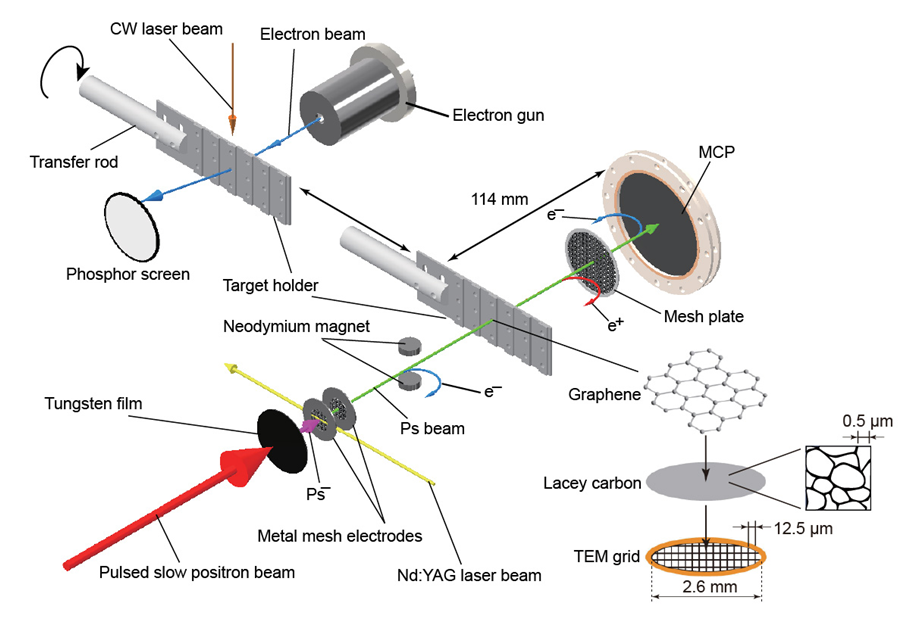
Image title: Demonstrating Wave-Particle Duality in Positronium
Image caption: Using a highly coherent positronium beam, the researchers observed clear diffraction patterns after transmission through a graphene film, confirming its wave-like behavior.
Image credit: Professor Yasuyuki Nagashima from Tokyo University of Science, Japan
Image link: https://doi.org/10.1038/s41467-025-67920-0
License type: CC BY 4.0
Usage restrictions: Credit must be given to the creator.
Reference
| Title of original paper | : | Observation of positronium diffraction |
| Journal | : | Nature Communications |
| DOI | : | 10.1038/s41467-025-67920-0  |
About The Tokyo University of Science
Tokyo University of Science (TUS) is a well-known and respected university, and the largest science-specialized private research university in Japan, with four campuses in central Tokyo and its suburbs and in Hokkaido. Established in 1881, the university has continually contributed to Japan's development in science through inculcating the love for science in researchers, technicians, and educators.
With a mission of "Creating science and technology for the harmonious development of nature, human beings, and society," TUS has undertaken a wide range of research from basic to applied science. TUS has embraced a multidisciplinary approach to research and undertaken intensive study in some of today's most vital fields. TUS is a meritocracy where the best in science is recognized and nurtured. It is the only private university in Japan that has produced a Nobel Prize winner and the only private university in Asia to produce Nobel Prize winners within the natural sciences field.
■
Tokyo University of Science(About TUS)
About Professor Yasuyuki Nagashima
from Tokyo University of Science
Dr. Yasuyuki Nagashima is a Professor in the Department of Physics at Tokyo University of Science, Japan, specializing in positron and positronium physics. His research focuses on the properties of negative ions of positronium and the positronium beam. He also studies positron annihilation-induced ion desorption from solid surfaces. In 2020, he received the Hiroshi Takuma Memorial Prize from the Matsuo Foundation. His laboratory conducts fundamental research on exotic particle-matter interactions while developing new positron-based experimental techniques for applied physics.
About Associate Professor Yugo Nagata
from Tokyo University of Science
Dr. Yugo Nagata is an Associate Professor in the Department of Physics at Tokyo University of Science, Japan, specializing in positronium and atomic physics. In 2023, he received the Young Scientist Award of the Japanese Positron Science Society.
Funding information
This work was supported by JSPS KAKENHI (Grants Nos. JP25H00620, JP21H04457, and JP17H01074).