2026.01.09 Friday
Breakthrough in Thin-Film Electrolytes Pushes Solid Oxide Fuel Cells Forward
Researchers achieve record-setting oxide-ion conductivity at medium temperatures, paving the way for safer and more efficient power generation

Under the threat of climate change and geopolitical tensions related to fossil fuels, the world faces an urgent need to find sustainable and renewable energy solutions. While wind, solar, and hydroelectric power are key renewable energy sources, their output strongly depends on environmental conditions, meaning they are unable to provide a stable electricity supply for modern grids. Solid oxide fuel cells (SOFCs), on the other hand, represent a promising alternative; these devices produce electricity on demand directly from clean electrochemical reactions involving hydrogen and oxygen.
However, existing SOFC designs still face technical limitations that hinder their widespread adoption for power generation. SOFCs typically rely on bulk ceramic electrolytes and require high operating temperatures, ranging from 600-1,000 ℃. This excessive heat not only forces manufacturers to use expensive, high-performance materials, but also leads to earlier component degradation, limiting the cell's service life and driving up costs. Such extreme temperatures are necessary to overcome resistance that blocks the flow of oxide ions--the charge carriers--through the ceramic electrolyte. This issue, known as grain boundary resistance, is caused by defects and chemical barriers at the interfaces between ceramic particles.
To address this challenge, a research team led by Professor Tohru Higuchi from the Department of Applied Physics at Tokyo University of Science (TUS), Japan, developed an innovative electrolyte design. Their paper, made available online in the Journal of the Physical Society of Japan on December 19, 2025, and in Volume 95, Issue 1, on January 15, 2026, was co-authored by a second-year Master's Course student Mr. Ryota Morizane from the Graduate School of Advanced Engineering at TUS, as well as Assistant Professor Daisuke Shiga and Professor Hiroshi Kumigashira from the Institute of Multidisciplinary Research for Advanced Materials at Tohoku University, Japan.
The team's strategy involved fabricating ultra-thin electrolyte layers of samarium-doped cerium oxide (SDC), a material already known for its exceptional oxide-ion conductivity. Their key innovation was ensuring precise control over the material's structure during deposition of the films. Using single-crystal yttria-stabilized zirconia (YSZ) as a substrate, the researchers directed the SDC crystals to align themselves in a specific direction--known as the a-axis orientation--across the entire thin film. This highly controlled crystal orientation minimized the structural imperfections that typically cause high grain boundary resistance and limit oxide-ion conductivity.
"We thought if we could fabricate an oriented film based on SDC with a large number of oxygen vacancies on YSZ as a substrate, we could achieve high oxide-ion conductivity at a practical level, higher than that of the existing materials," says Prof. Higuchi
The researchers tested their new thin-film electrolyte design through a series of experiments and analytical measurements. They found that the structurally ordered SDC thin film achieved world-record-high oxide-ion conductivity at temperatures between 200-550 ℃. Operating in this temperature range, rather than the standard 600-1,000 ℃, can drastically improve the practicality and safety of fuel cell technology. By requiring less heat, the system is less prone to material stress. In turn, this enables the use of less expensive components, speeds up the cell's start-up time, and increases overall energy efficiency. "Our findings suggest that a-axis-oriented SDC thin films with high chemical stability are promising as innovative electrolyte materials for practical SOFCs," states Prof. Higuchi.
This green energy innovation directly addresses one of the key roadblocks preventing the mass adoption of hydrogen power. By making SOFCs safer, durable, and more cost-effective, the proposed solution could help accelerate the transition away from fossil fuels and toward a hydrogen economy.
Notably, this development is not limited to power generation alone, as Prof. Higuchi explains, "The proposed thin films with high oxide-ion conductivity have interesting potential applications not only in fuel cells but also in all-solid-state electric double layer transistors based on ionic conductors, which can be used in brain-inspired computing." Thus, the implications of this materials science breakthrough could extend beyond energy solution technologies to state-of-the-art computing.
If an electrode material that can maximize the performance of this electrolyte membrane is discovered in the future, practical application could be feasible. If more research using the sputtering method is reported around the world, the technology can be commercialized. Further efforts in this field will hopefully pave the way for affordable clean energy in the near future.
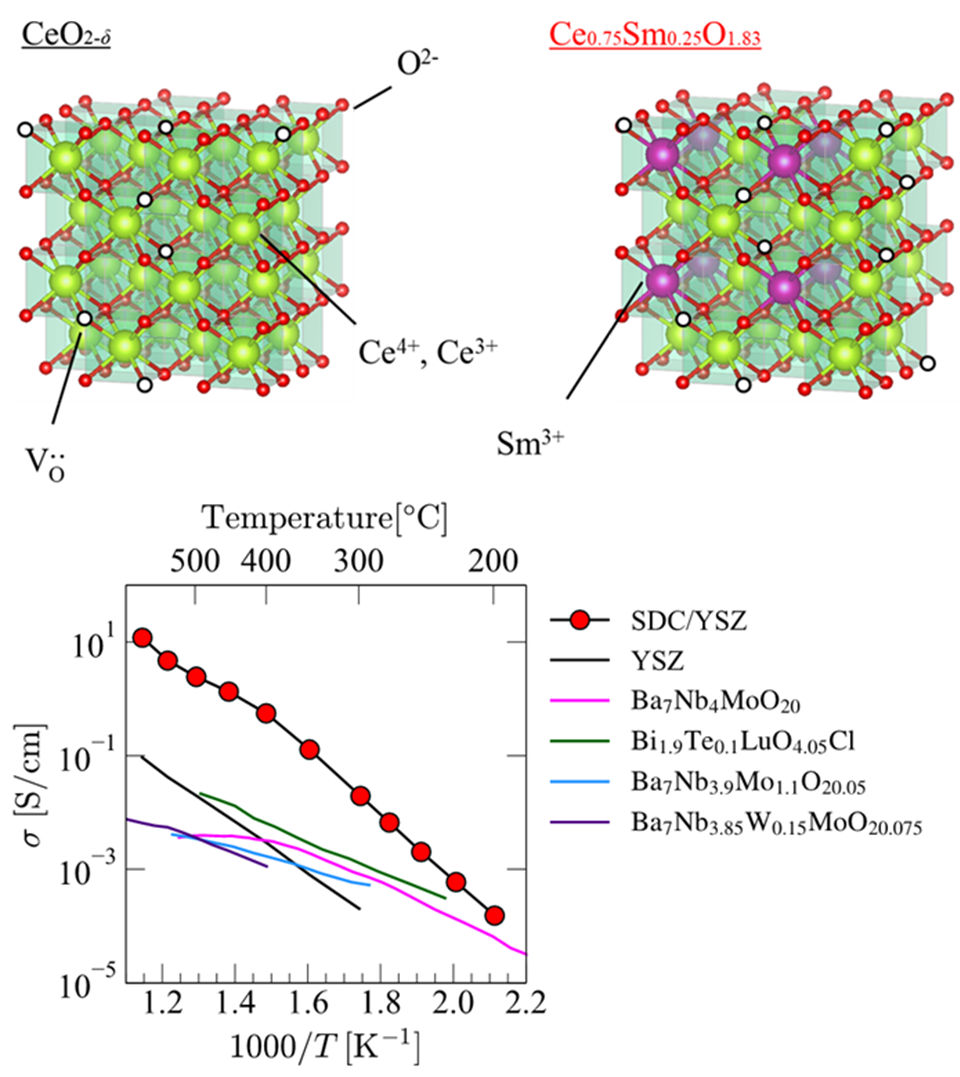
Image title: New thin-film electrolyte design outperforms existing solutions
Image caption: The highly oriented Sm-doped CeO2 thin films developed in this study achieved remarkable oxide-ion conductivities over a wide temperature range.
Image credit: Professor Tohru Higuchi from Tokyo University of Science, Japan
Image link: https://journals.jps.jp/doi/10.7566/JPSJ.95.014706
License type: CC BY 4.0
Usage restrictions: Credit must be given to the creator
Reference
| Title of original paper | : | Oxide Superionic Conductivity of a-Axis-Oriented Ce0.75Sm0.25O2-δ Thin Film on Yttria-Stabilized Zirconia Substrate |
| Journal | : | Journal of the Physical Society of Japan |
| DOI | : | 10.7566/JPSJ.95.014706 |
About The Tokyo University of Science
Tokyo University of Science (TUS) is a well-known and respected university, and the largest science-specialized private research university in Japan, with four campuses in central Tokyo and its suburbs and in Hokkaido. Established in 1881, the university has continually contributed to Japan's development in science through inculcating the love for science in researchers, technicians, and educators.
With a mission of "Creating science and technology for the harmonious development of nature, human beings, and society," TUS has undertaken a wide range of research from basic to applied science. TUS has embraced a multidisciplinary approach to research and undertaken intensive study in some of today's most vital fields. TUS is a meritocracy where the best in science is recognized and nurtured. It is the only private university in Japan that has produced a Nobel Prize winner and the only private university in Asia to produce Nobel Prize winners within the natural sciences field.
■
Tokyo University of Science(About TUS)
About Professor Tohru Higuchi
from Tokyo University of Science
Dr. Tohru Higuchi serves as Professor at the Department of Applied Physics at Tokyo University of Science. He received his bachelor's degree in Applied Physics from Tokyo University of Science in 1995, where he later earned his master's and PhD degrees. His research focuses on functional material science, with a particular emphasis on thin-film/surface and interfacial physical characteristics, as well as inorganic industrial materials. He has published over 220 articles and earned several honors, including those for his contributions to the GREEN-2019 conference and the 2019 International Symposium on Advanced Material Research.
Funding information
This work was partially supported by a Grant-in-Aid for Scientific Research (25K01661) from the Japan Society for the Promotion of Science (JSPS).