2025.12.04 Thursday
Seeing Inside Smart Gels: Scientists Capture Dynamic Behavior Under Stress
A rheo-impedance technique reveals how mechanical forces and heat reshape gel structure and function

Advances in materials science have led to the development of "smart materials," whose properties do not remain static but change in response to external stimuli. One such material is poly(N-isopropylacrylamide), or PNIPAM, a polymer gel that alters its solubility with temperature. The polymer contains hydrophilic amide groups and hydrophobic isopropyl groups. At low temperatures, the amide groups form strong hydrogen bonds with water, keeping the material well-swollen and soluble. However, as the temperature increases, these hydrogen bonds weaken while hydrophobic interactions strengthen, causing the polymer chains to collapse into compact globules. This transition occurs at the lower critical solution temperature (LCST), which is approximately 32 ℃, close to human body temperature. This makes PNIPAM especially attractive for biomedical applications. For instance, it can carry bioactive molecules while swollen and release them in the body by deswelling. Furthermore, since shear forces from bodily fluids are present inside human body, investigating PNIPAM behavior under specific conditions is crucial.
Though there are multiple studies on the phase transitions of these smart gels, research on internal structure and electrical conductivity remain unelucidated. Against this backdrop, a new study was made available online on November 11, 2025, and published in Volume 41, Issue 46 of the journal on Langmuir on November 25, 2025, and was conducted by Associate Professor Isao Shitanda of the Department of Advanced Chemistry at Tokyo University of Science (TUS), Japan, in collaboration with Master's student Mr. Haruna Tsunegi, TUS; Dr. Yuichi Takasaki, Anton Paar Japan K. K.; Visiting Professor Yoshifumi Yamagata, Anton Paar Japan K. K. and Research Institute for Science and Technology; Dr. Keisuke Miyamoto, Anton Paar Japan K.; and Professor Kazutake Takada, Nagoya Institute of Technology, Japan.
"No studies have observed microscopic structural changes within the gel under shear stress conditions, or variations in electrical conductivity within the gel arising from macroscopic structural changes during phase transitions. Our findings are expected to be highly useful for understanding the functional mechanisms of temperature-responsive polymer gels under flow conditions," says Dr. Shitanda.
To investigate this behavior, the researchers built a rheo-impedance device. It combines a rheometer and a potentiostat. Rheometer measures how stiff or soft the gel becomes under force and potentiostat measures the movement of electrical charges through the gel. They also used small-angle X-ray scattering (SAXS) to directly observe how the gel's internal structure rearranged during heating.
In their experiments, the team repeatedly heated and cooled the gel between 20-50 ℃ while applying controlled shear strains to the material, simulating real-time applications. During these cycles, they continuously measured how the gel's electrical impedance changed across a broad spectrum of frequencies.
Below the LCST, the gel behaves like a hydrated, flexible network where ions move easily, which results in good electrical conductivity. Once the temperature rises above the LCST, hydrophobic regions form inside the gel. These regions act like tiny insulating patches that block ion movement, causing charge to build up and altering both resistance and capacitance.
Shear strain produced additional effects. At low strains between 1-5%, the applied force pushed electrolyte solution out of the hydrophobic regions, opening up more conductive pathways. At moderate strains between 5-10%, continued shear expelled even more electrolyte from inside the gel, lowering conductivity. At high strains between 10-20%, the internal hydrophobic domains began to break apart. This created new gaps and rearranged the network in ways that increased conductivity once again.
These structural changes were confirmed using rheo SAXS measurements, which showed the gel shifting from a uniform network to a phase-separated structure with distinct hydrophilic and hydrophobic domains under stress.
PNIPAM is already used in drug delivery systems, cell scaffolds, and micro actuators because of its temperature-sensitive mechanical and electrical behavior. PNIPAM is highly biocompatible and could be loaded with drug. During delivery, the microgels are gathered at the target site and upon slight heating, phase transition occurs, leading to drug release. As the gel's internal structure is related to mechanical strength, PNIPAM could be used to design soft robots and flexible sensors. This novel rheo-impedance method provides a non-invasive way to probe the internal network of such gels and offers valuable guidance for developing the next generation of smart polymers. The researchers note that this approach could be applied to quality control in gel-based products such as cosmetics, foods, and pharmaceuticals, as well as to polymer electrolytes.
"Unlike conventional static measurements, this approach enables dynamic in situ evaluation of functional transitions within hydrogels and establishes a methodological foundation for extending rheo-impedance analysis. This is expected to become a new evaluation method for improving the durability of materials," says Dr. Shitanda.
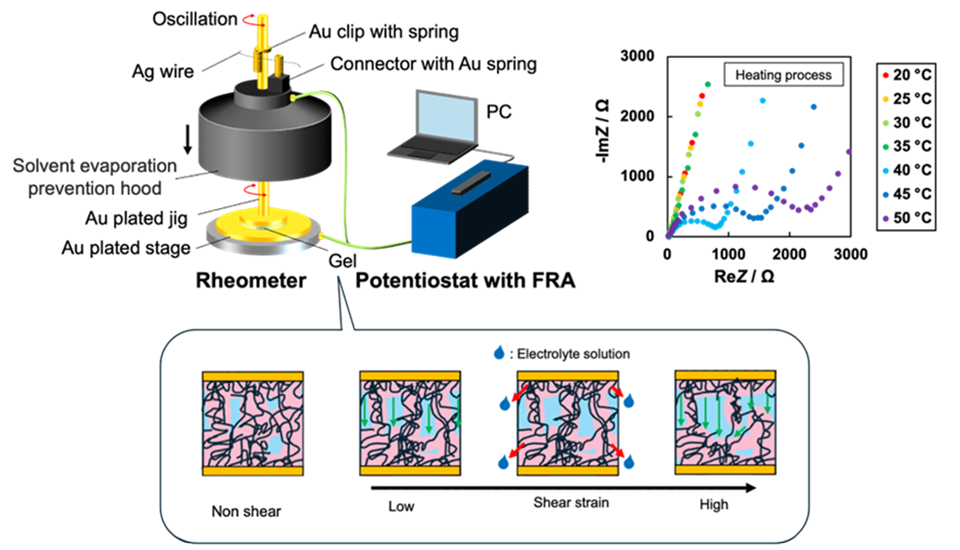
Image title: Probing polymer gel networks with rheo-impedance
Image caption: Schematic of the custom rheo-impedance device, which simultaneously applies shear stress and measures the gel's changing electrical properties. This device can dynamically and non-invasively reveal how the gel's internal structure and conductivity evolve under real-world conditions, providing crucial data for designing better smart materials.
Image credit: Dr. Isao Shitanda from Tokyo University of Science
Image link: https://pubs.acs.org/doi/10.1021/acs.langmuir.5c04227
License type: CC BY-NC-ND 4.0
Usage restrictions: Credit must be given to the creator. Only noncommercial uses of the work are permitted. No derivatives or adaptations of the work are permitted.
Reference
| Title of original paper | : | Rheo-Impedance Measurements for the Evaluation of Thermoresponsive Polymer Gels |
| Journal | : | Langmuir |
| DOI | : | 10.1021/acs.langmuir.5c04227 |
About The Tokyo University of Science
Tokyo University of Science (TUS) is a well-known and respected university, and the largest science-specialized private research university in Japan, with four campuses in central Tokyo and its suburbs and in Hokkaido. Established in 1881, the university has continually contributed to Japan's development in science through inculcating the love for science in researchers, technicians, and educators.
With a mission of "Creating science and technology for the harmonious development of nature, human beings, and society," TUS has undertaken a wide range of research from basic to applied science. TUS has embraced a multidisciplinary approach to research and undertaken intensive study in some of today's most vital fields. TUS is a meritocracy where the best in science is recognized and nurtured. It is the only private university in Japan that has produced a Nobel Prize winner and the only private university in Asia to produce Nobel Prize winners within the natural sciences field.
■
Tokyo University of Science(About TUS)
About Associate Professor Isao Shitanda
from Tokyo University of Science
Dr. Isao Shitanda graduated from the Tokyo University of Science (TUS) in 2001 and received a Ph.D from The University of Tokyo, Japan, in 2006. Since 2020, he has served as an Associate Professor at the Department of Pure and Applied Chemistry at TUS, leading the Itagaki/Shitanda lab. Dr. Shitanda specializes in electrochemical micro/nano systems, physical and analytical chemistry, bio-related chemistry, and environmental chemistry, among others. He has published over 180 papers and holds 10 patents. He has received multiple awards for his immense contributions, which includes "Supplemental Cover of Langmuir, 2025" and "Bimonthly Most Downloaded Papers, 2024."