
Tokyo University of Science has three faculties and 12 departments where students can obtain their teaching licenses. Every year, many students obtain teaching licenses for middle school (mathematics and science) and high school (mathematics, science, and information). In addition to the specialized courses in their respective departments, students can obtain a teaching license by completing the prescribed subjects on the teacher training course and applying for a license from a prefectural board of education. In addition, students can become teachers by passing the teacher recruitment examination for public schools and the various recruitment procedures of their own for private schools. Many students at Tokyo University of Science aim to obtain a teaching license. Some departments have more than 50% of students taking the teacher training course. As Professor Okiharu explains, “Students will acquire the knowledge and skills necessary to become teachers while developing their expertise in their respective departments and faculties. Supporting this teacher training is the Center for Teacher Education, a permanent institution where full-time and part-time faculty members provide instruction by drawing on their research fields and teaching experience. In other words, students can learn at the forefront of the sciences while simultaneously developing the ability to serve as educators.” In Natsume Soseki’s novel Botchan, the protagonist, a graduate of the Tokyo Academy of Physics, the precursor to Tokyo University of Science, is transferred to Matsuyama, in Shikoku, as a teacher. Even today, after a long passage of time, many graduates of the university work as teachers at junior high and high schools.

In the teacher training course, one of the subjects that students pursuing a Type 1 junior high school teaching license (science) or Type 1 high school teaching license (science) must take is Theory of Science Education. That is because this class is one of the requirements for participating in the fourth-year teaching internship, considered the culmination of the teaching training course. The first semester’s Theory of Science Education 1 deals with middle school science, while the second semester’s Theory of Science Education 2 deals with high school science (physics, chemistry, biology, and geology). As Professor Okiharu explains, “The four courses that cover how to teach science are Science Teaching Methods 1 and 2, and Theory of Science Education 1 and 2. Theory of Science Education covers a wide range of topics, including the theoretical aspects of science education, cutting-edge teaching methods based on the results of educational research, and how Japanese students’ academic performance in science compares with international standards.” Although the subject is titled Theory of Science Education, it is a practical class that aims to equip students with knowledge and basic teaching skills that will serve them well when they go to junior high and high schools for their teaching internships.
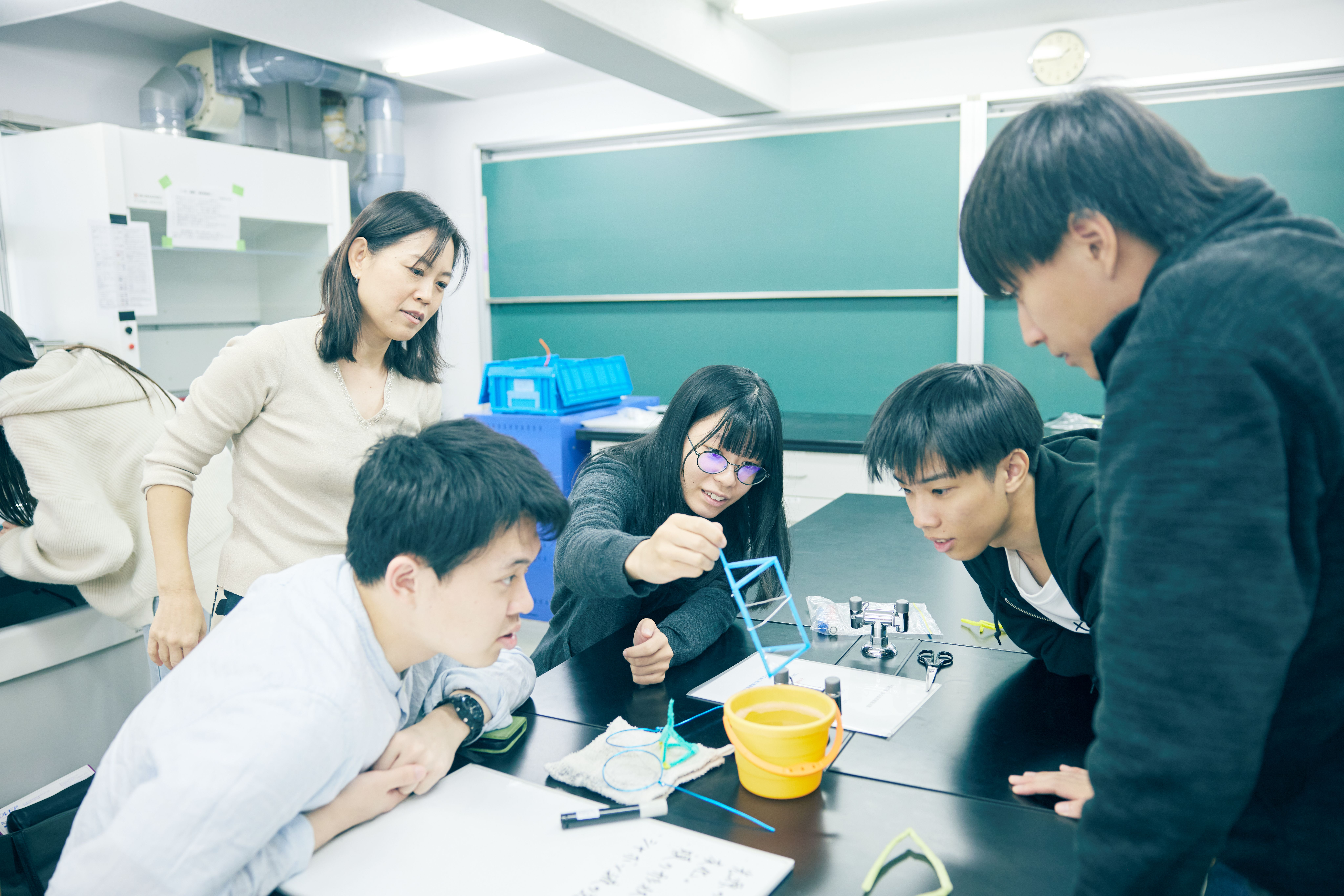
There are two major features of Theory of Science Education 2 at Tokyo University of Science. The first is that it deals with what kind of discipline science is, scientific ethics (including bioethics), and the relationship between science and culture/society. For example, it involves discussion of the textbook Twenty First Century Science, developed in the United Kingdom. In today’s world, there are many problems that cannot be solved by science alone. As Professor Okiharu explains, “I believe that when students become teachers, the experience of these discussions will bear fruit in terms of being able to equip their own students with the ability to think for themselves.” The second is that it involves conducting inquiry activities, including experiments, as if the students were themselves learning at high school. Professor Okiharu recalls, “One past example involved students investigating the electrical resistance of mechanical pencils with leads of different hardnesses. However, since that does not constitute an inquiry activity in itself, I had the students hold group discussions and present their findings, including on where the difficulties in teaching lie and how to guide students when they get stuck in their experiments and discussions.” Currently, inquiry is one of the key words in the school curriculum guidelines. In order to develop students who can engage in inquiry on their own, it is vital for teachers to have this experience as well. In this way, a new approach to education, one that is not simply a reproduction of the education that student teachers have received themselves, is steadily taking shape.
■ Main research themes