
ハラダ カズノリ
原田 和典
教授
東京理科大学 創域理工学研究科 国際火災科学専攻
| 研究室名 |
国際火災科学専攻 原田研究室
|
| トピックス |
建築物における火災拡大のメカニズムを解明し、火災に安全な建物を工学的に設計・建設する方法を研究する。
|
| 専攻分野 |
建築火災安全工学
|
| 研究分野 |
可燃物の燃え拡がり予測、内装材料の燃焼性、室内における煙拡散性状、構造部材の熱的挙動
|
| 紹介 |
建築物における火災拡大のメカニズムとして、室内での可燃物の燃え拡がり、内装材料の燃焼性、室内における煙拡散性状、構造部材の熱的挙動を解明してモデル化する。その成果に基づき、火災に安全な建物を工学的に設計・建設する方法を研究する。
|
| 研究テーマ |
-
建築物の実況に基づく火災性状予測 / Fire Behavior Prediction Based on Actual Conditions of Buildings
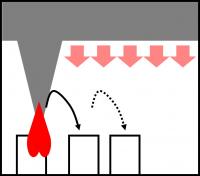
建築物の室内には多種多様な可燃物があり、その配置も部屋によって異なります。そのため、実際に起こる火災の激しさも一様ではありません。もし設計時にそこで起こる火災の激しさをあらかじめ予測できれば、必要な対策を講じて建物の安全性を確保できます。さらに、建物が完成して使われ始めてからも、その時々の実況に応じて火災性状を正しく推定することが重要です。本研究は、複数の可燃物が室内で燃焼するメカニズムを予測し、より確かな火災安全設計に役立てることを目標としています。
Building interiors contain a wide variety of combustible materials, and their layout varies from room to room. Consequently, the intensity of actual fires is not uniform. If the intensity of a fire that might occur in a given location can be predicted in advance during the design phase, the necessary measures can be taken to ensure the building’s safety. Furthermore, even after a building is completed and begins to be used, it is important to accurately estimate fire behavior based on the actual conditions at any given time. The objective of this study is to predict the mechanisms by which multiple combustible materials burn indoors and to use these findings to contribute to more reliable fire safety design.
-
室内での可燃物の燃焼性状 / Combustion Behavior of Combustible Materials in a Room
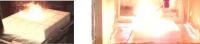
可燃物がどれほど激しく燃えるかは、その物質自体の性質だけでなく、燃える場所の環境によっても大きく変わります。一般に、周囲に壁や天井がないオープンな「自由空間」に比べ、部屋の中(室内)での燃焼はより激しくなります。写真はウレタンマットレスの燃焼実験の様子です。全く同じ物を燃やしても、左の自由空間での燃焼に比べて、右の室内での燃焼の方が激しく燃え拡がっていることが分かります。本研究では、自由空間での燃焼データをもとに、室内での燃焼性状を予測するモデルの開発に取り組んでいます。
How intensely a combustible material burns depends not only on the properties of the material itself but also varies significantly depending on the environment in which it burns. In general, combustion inside a room is more intense than in an open “free space” without surrounding walls or a ceiling. The photo shows a combustion test on a urethane mattress. Even when burning exactly the same material, you can see that the fire spreads more intensely indoors (on the right) than in the open space (on the left). In this research, we are working to develop a model that predicts indoor combustion behavior based on combustion data collected in open spaces.
-
可燃性内装の燃焼性状 / Combustion Behavior of Combustible Interior Finishes
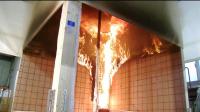
木材等の可燃性材料を室の内装とすると、火災の初期に材料表面に沿って燃え拡がりが起こることが心配されます。そのため、写真のような実験を行って燃え拡がり性状を予測しています。これをモデル化してシミュレーションにより燃え拡がりの速さを予測し、避難可能時間を推定する試みをしています。
When combustible materials such as wood are used for interior finishes, there is concern that fire will spread along the surface of these materials during the early stages of a fire. Therefore, experiments like the one shown in the photo are conducted to predict the spread of fire. We are attempting to model this behavior and use simulations to predict the rate of fire spread and estimate the time available for evacuation.
-
大断面木造の耐火性 / Fire Resistance of Large-Section Timber Structures
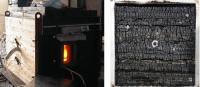
大規模建築物を木造で建設するためには、耐震性や耐風性に加え、耐火性も必要になります。特に高層建物では、避難行動や消火活動を行っている間に建物が崩壊すると人命に直結する深刻な事態となります。写真左は厚さ100mmの壁の耐火試験です。壁表面は写真右のように完全に炭化しますが、内部は健全なまま残ります。表面の残火も自然に消えるようになれば壁は燃え残り崩壊を免れます。このような設計は燃え止まり設計と呼ばれており、その基本的な考え方を研究しています。
To construct large-scale buildings using wood, fire resistance is required in addition to seismic and wind resistance. In high-rise buildings in particular, if the building collapses while people are evacuating or firefighters are battling the blaze, it can lead to a serious situation that directly threatens human lives. The photo on the left shows a fire resistance test on a 100-mm-thick wall. While the wall’s surface is completely charred, as shown in the photo on the right, the interior remains intact. If the residual flames on the surface eventually extinguish naturally, the wall will survive the fire and avoid collapse. This type of design is known as a “self-extinguishing design,” and we are researching its fundamental principles.
|

